Last updated: August 18, 2026
Pickleball looks simple from the sideline: a small court, a plastic ball, paddles that look like oversized ping pong bats. Then you watch a rally up close and notice the soft, patient shots landing just past the net, the sudden speed-up, the players standing well behind a painted line waiting for their turn to move forward. Learning how to play pickleball means understanding a handful of rules that work together, not memorizing a long list in isolation.
This guide walks through the whole picture: what you need before you start, how a serve and a point actually unfold, how the score is kept, and where beginners most often trip up. By the end you should have a solid handle on pickleball basics, enough to walk onto a court, understand what everyone around you is doing, and play a full game without needing someone to referee every shot.
Quick Answer
How do you play pickleball?
- Two or four players hit a plastic ball over a low net on a court roughly the size of a badminton court, using solid paddles instead of rackets.
- Only the serving side can score a point in the traditional side-out format, games are typically played to 11 points and won by two, and every serve must clear a no-volley zone called the kitchen before the ball can be smashed out of the air.
- The serve must go in diagonally, the ball must bounce once on each side before anyone volleys it, and after that the point plays out like a fast, low-to-the-ground rally.
Pickleball at a Glance
Before the details, here is the whole game compressed into one table. Every row below gets its own explanation further down the page.
| Element | What it means |
|---|---|
| Court | 20 by 44 feet (6.10 by 13.41 meters), the same size for singles and doubles |
| Equipment | A solid paddle per player and a lightweight perforated plastic ball |
| Serve | Underhand, below the waist, hit diagonally into the opponent’s service court |
| Double bounce rule | The ball must bounce once on the return and once on the serve before either side can volley it |
| Kitchen | A 7-foot no-volley zone on each side of the net where players cannot hit the ball out of the air |
| Scoring | Traditional format: only the serving side scores; games usually go to 11, win by 2 |
What You Need to Play
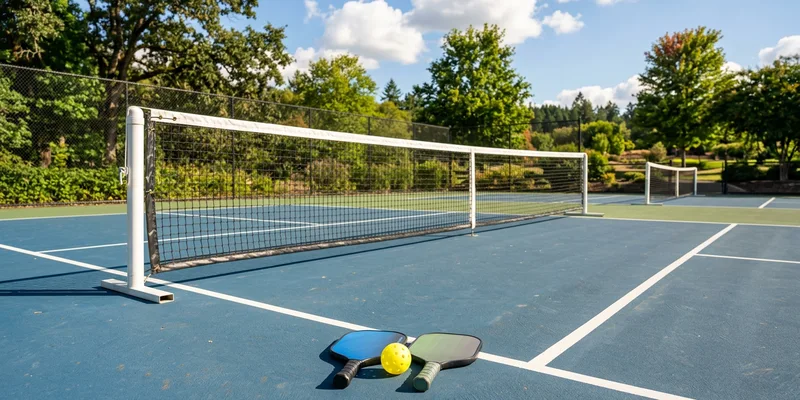
The equipment list is short by design. Each player needs a paddle, a solid, slightly textured face attached to a short handle, smaller than a tennis racket and without strings. Everyone on the court shares a single ball, a hollow plastic sphere covered in round holes, made in separate indoor and outdoor versions because the two surfaces behave differently in the air. The court itself is roughly the size of a doubles badminton court, divided by a net that sits lower than a tennis net.
Beyond the basics, comfortable athletic shoes with lateral support matter more than most beginners expect, since pickleball involves a lot of quick side-to-side movement on a hard surface. If you are shopping for your first setup, our beginner paddle guide walks through what actually matters when you are choosing between models, without assuming any prior experience.
How to Serve
Every point starts with a serve, and the serve has its own small rulebook. The server must strike the ball underhand, below waist level, with the paddle head moving in an upward arc, and the ball has to land inside the diagonally opposite service court, past the kitchen line. Miss the diagonal box, hit the net, or serve from the wrong position, and the serve is a fault, which ends the service turn.
The serving position itself depends on the score: the server stands on the right side of the court when their team’s score is even, and on the left side when it is odd. That single rule, repeated every point, is what keeps players in the correct spot without anyone having to think too hard about it once it becomes habit. The full serve rulebook covers a few extra details, like exactly where the ball can bounce and which serve variations are legal, but this positioning rule is the one you will use on every single point.
The Double Bounce Rule and the Kitchen
Two rules shape almost every point, and they work together. First, the double bounce rule: after the serve, the receiving side must let the ball bounce once before returning it, and the serving side must then let that return bounce once as well before hitting it back. Only after both of those bounces have happened can either side volley the ball, meaning strike it out of the air before it touches the ground.
Second, the kitchen, officially the non-volley zone, is a 7-foot strip on each side of the net where players are not allowed to volley the ball, even if only a foot is touching the line when they swing. Players can stand in the kitchen and can step into it to play a ball that has bounced, they simply cannot hit a ball out of the air while any part of them touches that zone. Together, these two rules slow the game down just enough to create the long, patient rallies pickleball is known for, rather than a game decided entirely at the net.
How Scoring Works
In the traditional format, only the serving side can add to its score. If the receiving side wins a rally, no point is scored, but the serve passes to them instead, called a side-out. Games are usually played to 11 points, and a team must win by at least 2, so a game can stretch past 11 to 11 if both sides keep trading points near the end.
Doubles play adds one more layer: both partners typically get a turn to serve before the serve passes to the other team, with an exception at the very start of each game so the first server does not get an unfair head start. That sequence, along with how the score is called out loud during a doubles match, is detailed in our doubles rules guide. Some organizers also run a rally scoring format, where every rally awards a point regardless of who served, though the traditional side-out format remains the default for most casual and sanctioned play.
A Typical Point, Step by Step
Picture a doubles game to make the flow concrete. The server stands behind the baseline on the correct side, serves diagonally into the opposite service box, and the receiving team lets it bounce before returning it. The serving team then lets that return bounce as well, completing the double bounce rule, and from that point on either side may volley if they choose to.
Most points settle into a pattern after that: players work their way toward the kitchen line using soft, arcing shots that are hard to attack, a shot often called a dink, until someone gets an opening to speed the ball up and end the rally. A point ends when the ball lands out of bounds, hits the net and fails to cross, bounces twice on one side, or a player commits a fault such as volleying from inside the kitchen. Whoever wins that exchange either scores a point, if they were serving, or earns the right to serve next.
Common Mistakes Beginners Make
- Volleying while touching the kitchen. Momentum after a swing counts too; stepping into the zone right after you hit a volley is still a fault.
- Forgetting the double bounce rule. New players often try to volley the return of serve, which is illegal until both bounces have happened.
- Serving overhand or above the waist. The underhand, below-waist motion is a hard requirement, not a style choice.
- Losing track of the score sequence. In doubles especially, knowing who is serving and which service box to stand in takes a few games to become automatic.
- Standing too far back after the serve. Most points are won and lost near the kitchen line, so staying stuck at the baseline gives up court position.
- Trying to power every shot. Pickleball rewards patience early in a rally far more than it rewards a hard first swing.
Frequently Asked Questions
Do you need to be athletic to play pickleball? No. The court is small, the pace can be adjusted, and many players pick up the basics in a single session. Fitness helps at higher levels, but it is not a barrier to starting.
Can you play pickleball with just two people? Yes, that is singles play, which uses the same court and net but different serving and positioning rules than the doubles format described above.
What happens if the ball hits the net during a rally? If the ball clears the net and lands in play after touching it, the point continues normally. Only a serve that clips the net and still lands in the correct box is treated differently, and that specific case is covered in the full serve rulebook.
How long does a typical game take? A single game to 11 points usually takes somewhere around 15 to 25 minutes, depending on skill level and how many side-outs happen along the way, so most sessions fit in several games.
Is pickleball closer to tennis or table tennis? It borrows elements from both, plus badminton, but it has its own rulebook and rhythm all its own.
Do beginners need an expensive paddle to start? No. An entry-level paddle is enough to learn the game and figure out what you actually want from a second one later.
The Bottom Line
Playing pickleball comes down to a small set of rules that reinforce each other: a diagonal underhand serve, a double bounce before anyone can volley, a no-volley kitchen near the net, and side-out scoring up to 11. Learn those four pieces and the rest of the game, positioning, strategy, shot selection, develops naturally with time on the court. For the full rulebook in one place, start with our complete pickleball rules guide.