Last updated: August 18, 2026
If you are standing on a slab with a tape measure and a roll of tape, you do not need an explanation of why the kitchen exists. You need every number in feet and inches, in the order you will use them, without converting anything. That is what this page is for.
Below is the full set of pickleball court dimensions in feet, from the outer boundary down to the width of the lines themselves and the height of the net at two different points. Every figure follows the USA Pickleball rulebook, which is reviewed at the start of each year, so check the current rulebook before painting anything permanent. For the reasoning behind the layout and what each zone does during a rally, our court dimensions guide covers the same court from the player’s side.
Quick Answer
What are the pickleball court dimensions in feet?
- The court is 20 feet wide by 44 feet long, measured to the outside edge of the lines.
- Each non-volley zone is 7 feet deep by 20 feet wide, and each of the four service courts is 10 feet wide by 15 feet long.
- Lines are 2 inches wide, the net sits 36 inches high at the sidelines and 34 inches at the center, and the posts stand 22 feet apart.
Every Measurement in Feet, in One Table
This is the whole court as a reference chart. Work down the list in order and you will mark out a regulation layout without needing a second source.
| Measurement | In feet and inches |
|---|---|
| Court width | 20 ft |
| Court length | 44 ft |
| Net to baseline, each side | 22 ft |
| Non-volley zone depth, each side | 7 ft |
| Non-volley zone width | 20 ft, the full court width |
| Kitchen line to baseline | 15 ft |
| Service court width | 10 ft each |
| Service court length | 15 ft each |
| Line width | 2 in |
| Net height at the sidelines | 36 in (3 ft) |
| Net height at the center | 34 in |
| Distance between net posts | 22 ft |
| Minimum recommended play area | 30 by 60 ft |
| Comfortable recreational play area | 34 by 64 ft |
The Outer Rectangle: 20 by 44 Feet
Start with the boundary. The court is 20 feet wide and 44 feet long, and those measurements run to the outside edge of the boundary lines rather than to their inside edge. That means the tape you lay down sits inside the 20 by 44 measurement, not outside it, which is the single detail most likely to throw a home layout off by a few inches.
The rectangle is identical for singles and doubles, so there is no second set of sidelines to mark. Once the outer boundary is square, every other line on the court is measured from it or from the net line at the midpoint.
The Non-Volley Zone: 7 Feet from the Net
Measure 7 feet back from the net on each side and mark a line across the full 20-foot width. That strip is the non-volley zone, universally called the kitchen, and the two of them together account for 14 of the court’s 44 feet. The kitchen is not divided into left and right halves, so no center line runs through it.
The kitchen line itself belongs to the zone for rule purposes, which is why the 2-inch line width is worth marking accurately rather than eyeballing. What that means during play is covered in the kitchen rules guide.
The Service Courts: 10 by 15 Feet Each
Behind each kitchen line sits a 15-foot strip that runs from the kitchen line back to the baseline. A center line splits that strip into two service courts of 10 by 15 feet each, giving four service courts on the full court. The center line starts at the kitchen line and stops at the baseline; it never continues into the kitchen.
Those 10 by 15 foot boxes are the target for every serve. A serve must clear the kitchen line and land inside the diagonally opposite box, and on the serve specifically the kitchen line counts as out, which makes accurate marking of that line more than a cosmetic concern.
Line Width: The Two Inches People Forget
All lines on a regulation court are 2 inches wide. On a 44-foot court that sounds trivial, but it compounds: if you center each line on its measurement instead of placing it correctly relative to the boundary, every zone shifts by an inch and the cumulative error is visible by the far baseline.
The practical rule is that boundary lines are measured to their outside edge, and interior lines such as the kitchen line and center line are measured to the edge that faces the zone they define. Use a chalk line or a string pulled tight rather than freehanding a 20-foot run, and check both diagonals of the rectangle for equal length before anything becomes permanent.
Net Measurements in Feet and Inches
The net spans 22 feet from post to post, a foot wider than the court on each side, and it hangs 36 inches high at the sidelines and 34 inches at the center. That 2-inch sag is intentional and built into regulation nets, so a net pulled perfectly level across its whole width is actually set wrong.
Portable systems vary in how well they hold those two heights through a session, which is the main practical difference between them once the frame is up. If you are buying rather than measuring an existing setup, our pickleball net guide covers what keeps a net at the right height instead of sagging into the low thirties by the third game, and the net height guide explains how to check yours.
Total Play Area in Feet
The 20 by 44 foot figure is the court, not the space it needs. Guidance built on USA Pickleball standards puts the minimum usable area at 30 by 60 feet, a comfortable recreational area at 34 by 64 feet, and a tournament-style area at 40 by 70 feet. The extra footage becomes run-off room behind the baselines and along the sidelines.
Translated into clearance, a 34 by 64 foot layout leaves 7 feet on each side and 10 feet behind each baseline. Measure that space to the nearest fence, wall or pole rather than to a property boundary, since anything a player can run into is the real edge.
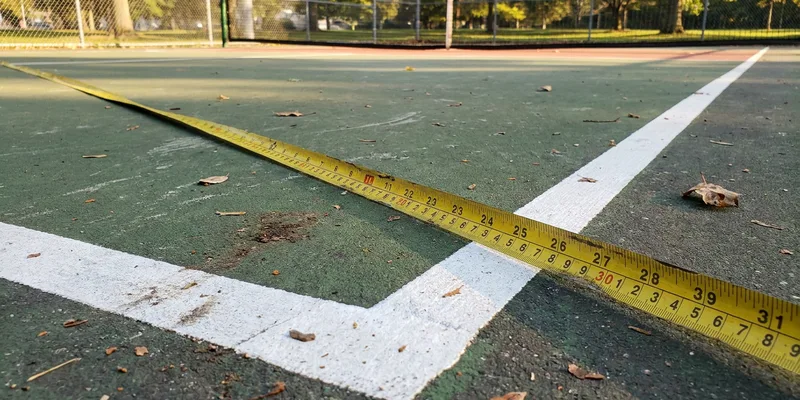
Marking a Court with a Tape Measure
Work in this order: outer rectangle first, then the net line at the 22-foot midpoint, then the two kitchen lines 7 feet from the net line, then the center lines in each 15-foot backcourt. Confirm the rectangle is square by measuring both diagonals, which should be equal at roughly 48 feet 4 inches on a correct 20 by 44 layout, or by using the 3-4-5 triangle method at each corner.
A long tape and two people beat a short tape and a lot of patience. Errors at the first corner travel the length of the court, so it is worth confirming the rectangle twice before any line goes down permanently.
Frequently Asked Questions
What are the pickleball court dimensions in feet? 20 feet wide by 44 feet long, with a 7-foot non-volley zone on each side of the net and four service courts of 10 by 15 feet.
How wide are pickleball court lines? Lines are 2 inches wide. Boundary lines are measured to their outside edge, so the tape or paint sits inside the 20 by 44 foot rectangle.
How far is the kitchen line from the net in feet? 7 feet on each side, running the full 20-foot width, for a combined 14-foot no-volley band across the middle of the court.
How tall is a pickleball net in inches? 36 inches at the sidelines and 34 inches at the center, with the slight dip built into a regulation net rather than being a sign of sagging.
How long is the diagonal of a pickleball court? On a correctly squared 20 by 44 foot court the diagonals measure roughly 48 feet 4 inches, which is the fastest way to confirm your corners are right.
Are the dimensions different for singles? No. The same 20 by 44 foot court and the same interior lines are used for singles and doubles alike.
The Bottom Line
In feet: a 20 by 44 foot court, a 7-foot kitchen on each side, 10 by 15 foot service courts, 2-inch lines, and a net 36 inches high at the sidelines and 34 inches at the center, with posts 22 feet apart. Allow at least 30 by 60 feet of total space around it. Measure to the outside edge of the boundary lines, check both diagonals before committing, and confirm the figures against the current USA Pickleball rulebook if the court will be used for sanctioned play.