Last updated: August 18, 2026
Pickleball and tennis look related at a glance, a net, a court, a paddle or racket, players trading shots back and forth. Once you actually stand on both courts, the resemblance thins out fast. The pickleball vs tennis comparison is really a comparison of two sports that share an ancestor but grew in different directions, one built for quick, close-quarters exchanges, the other for court coverage and sustained power.
This guide lines up the two sports side by side, court size, equipment, rules, pace, and physical demands, so you can see exactly where they diverge and where a background in one sport helps (or gets in the way) when you try the other.
Quick Answer
What’s the real difference between pickleball and tennis?
- A pickleball court is a fraction of the size of a tennis court, and points are typically shorter, with more net play and less running.
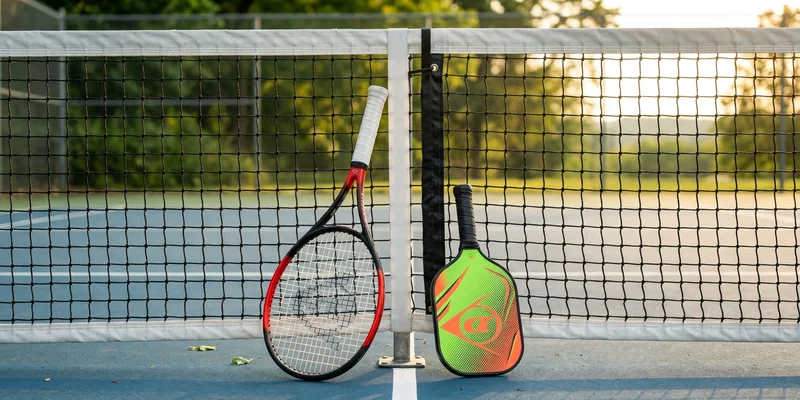
- Pickleball paddles are solid, stringless, and much shorter than a strung tennis racket, and the plastic, hole-covered ball behaves nothing like a felt tennis ball.
- Pickleball has a no-volley zone at the net (the kitchen) and a rule that both sides must let the ball bounce once before volleying; tennis has neither.
Bottom line: the two sports share a family tree but not a rulebook, and most players find pickleball’s learning curve gentler at the start.
Pickleball vs Tennis at a Glance
The table below is the shortcut version of this entire comparison. Each row is a category where the two sports genuinely diverge, not just a cosmetic detail. Read the summary here, then the sections below dig into why each difference matters on court.
| Category | Pickleball | Tennis |
|---|---|---|
| Court size | 44 ft x 20 ft, same for singles and doubles | 78 ft x 27 ft singles, 78 ft x 36 ft doubles |
| Equipment | Solid paddle, no strings; hard plastic ball with holes | Strung racket; pressurized felt-covered ball |
| Net height | 36 in at the sidelines, 34 in at the center | 3.5 ft at the posts, 3 ft at the center |
| Serve | Underhand, diagonal, below the waist | Overhand or underhand, diagonal, allowed multiple styles |
| Net rule | Non-volley zone (the kitchen) blocks volleys near the net | No restriction on where you can volley |
| Typical rally length | Shorter, more net exchanges | Longer, more baseline movement |
Court Size: The Starting Point for Everything Else
A pickleball court measures 44 feet by 20 feet, and that same footprint is used for both singles and doubles play. A tennis court is far larger: 78 feet by 27 feet for singles, and 78 feet by 36 feet for doubles once the alleys are added. In practical terms, up to four pickleball courts can fit on the full fenced footprint of a single tennis court, including the run-off space around the lines, which is why so many facilities have converted or overlaid tennis courts with pickleball lines.
The pickleball court vs tennis court size gap explains most of the other differences on this page. A smaller court means less ground to cover between shots, shorter sprints to the net, and rallies that reward quick hands over foot speed. That single measurement is the reason pickleball is often described as easier to pick up physically, even before you touch the equipment.
Net Height Differs Too
Tennis nets sit higher, 3.5 feet at the posts and dropping to 3 feet at the center, while pickleball nets are lower across the board, 36 inches at the sidelines and 34 inches at the center. The lower net, combined with the shorter court, is part of why net play and soft shots near the net are such a large part of pickleball strategy in a way they aren’t in recreational tennis.
Equipment: Paddle vs Racket
A tennis racket is strung, typically 27 inches long, and built to generate spin and pace off a large stringbed. A pickleball paddle is solid, with no strings at all, shorter overall, and designed more for control and touch than raw power. The two pieces of equipment are not interchangeable, and neither is the technique for swinging them.
The balls diverge just as much. Tennis uses a pressurized, felt-covered ball that compresses on contact and responds to spin. Pickleball uses a hard, hollow plastic ball with a pattern of holes, closer in spirit to a wiffle ball. It doesn’t compress the same way, it’s affected more by wind, and it produces a much lower-bouncing, lower-power game than a tennis ball does off a strung racket.
Rules That Don’t Exist in the Other Sport
Two pickleball rules have no tennis equivalent, and both shape how the game is played. The first is the non-volley zone, commonly called the kitchen, a 7-foot strip on each side of the net where players cannot hit the ball out of the air; the ball has to bounce first. The second is the two-bounce rule, which requires the receiving team to let the serve bounce and the serving team to let the return bounce before anyone can volley.
Tennis has no non-volley zone and no mandatory bounce rule; players can volley from anywhere on the court, including right at the net, from the first shot of the point onward. That’s a meaningful piece of the difference between pickleball and tennis in practice: pickleball structurally slows down the start of every point and pushes play toward the net, while tennis lets aggressive net play happen immediately if a player chooses it.
Scoring: Similar Idea, Different Numbers
Both sports use a serve, a boundary, and a point-based scoring system, but the numbers and structure differ. Tennis scores in games and sets, with points called love, 15, 30, 40, and game, and matches typically decided over two or three sets. Traditional pickleball scoring uses points that count up from zero, games are usually played to 11 (win by 2), and in the traditional format only the serving side can score a point.
Newer rally-scoring formats exist in pickleball where every rally scores a point regardless of who served, so scoring conventions are shifting somewhat as the sport grows, but the traditional serve-to-score format remains the one most beginners encounter first at a local court.
Pace, Rally Length, and Physical Demand
Tennis rallies, especially at the baseline, tend to run longer and cover more court, with players routinely sprinting side to side and front to back over a match. Pickleball rallies are generally shorter and more compact, with a lot of the action concentrated near the net once both players have worked their way forward under the two-bounce rule.
That doesn’t make either sport low effort. Pickleball trades long sprints for quick reflexes, short lateral steps, and sustained time on your feet, especially in doubles where the court gets crowded near the net. The physical load is different in kind, not simply lower, and both sports call for warming up, footwork, and reasonable fitness. Anyone managing an existing joint issue, recovering from an injury, or unsure how much activity is appropriate should get guidance from a doctor or physical therapist rather than assume one sport is automatically gentler on the body than the other.
Who Tends to Prefer Which Sport
Players coming from a racket sports background, especially tennis or badminton, usually pick up pickleball quickly because the hand-eye coordination transfers directly, even though the swing mechanics change. Complete beginners often find pickleball’s smaller court and slower ball more approachable than stepping straight onto a tennis court for the first time.
Tennis still holds appeal for players who want longer points, more running, and the specific feel of topspin off a strung racket, and it remains the deeper sport competitively, with a longer season structure and a much larger existing infrastructure of clubs and coaching. Neither sport replaces the other; plenty of players end up doing both, and time on one court often makes someone a more well-rounded athlete on the other.
Frequently Asked Questions
Is pickleball easier than tennis? Most beginners find pickleball’s smaller court and slower ball easier to pick up early on, but “easier” depends on your background; players with a tennis or badminton foundation often adapt fastest of all.
Can you use a tennis court for pickleball? Yes, many facilities overlay temporary lines on a tennis court, and up to four pickleball courts can fit on the full fenced footprint of one tennis court including its run-off space, though a permanent pickleball net is lower than a tennis net and usually needs its own setup.
Is it “pickle ball vs tennis” or “pickleball vs tennis”? Both point to the same comparison; pickleball is the standard one-word spelling used by USA Pickleball and most current sources, though “pickle ball” still shows up often in casual search.
Do pickleball and tennis skills transfer to each other? Hand-eye coordination, footwork, and court awareness transfer well in both directions, but the specific swing mechanics differ enough that most players need a short adjustment period switching sports.
Why is the pickleball court so much smaller than a tennis court? Pickleball was originally improvised on a badminton court, and the smaller dimensions stuck because they suit the paddle, the low-bouncing ball, and the net-focused style of play the sport developed around.
Is pickleball or tennis harder on the body? They load the body differently rather than one simply being lighter than the other; tennis involves more sustained running, while pickleball involves quick, repeated lateral movement near the net. Anyone with joint pain or an existing injury should check with a doctor or physical therapist before starting either sport.
The Bottom Line
Pickleball and tennis share a net and a scoring mindset, but the court size, equipment, and rules set them apart at almost every turn. Pickleball’s smaller court, solid paddle, lower net, and non-volley zone push the game toward quick net exchanges, while tennis rewards court coverage and power off a strung racket over longer rallies. Understanding the difference between pickleball and tennis helps explain why so many players end up trying both instead of picking just one.