Last updated: August 18, 2026
The third shot drop solves a problem that the rules of pickleball create on purpose. After the serve and the return, the serving team is stuck at the baseline while their opponents are usually already camped at the net, and the two-bounce rule means they cannot simply volley their way out of it. The third shot drop is how the serving team closes that gap without handing the point away.
This guide explains what the shot is, why the rules make it necessary rather than optional, and how to practice it on your own. It also covers the third shot drive, the shot’s more aggressive alternative, so you can see where each one fits.
Quick Answer
What is the third shot drop in pickleball?
- It is the softly arced shot the serving team plays on the third shot of a rally, aimed to land in the opponent’s kitchen while the server moves up from the baseline.
- It exists because the two-bounce rule keeps the serving team from volleying early, and a hard shot from the baseline is easy for net-side opponents to attack.
- A good drop lands low and short, giving the server time to reach the non-volley zone line before the next exchange.
How to Hit a Third Shot Drop, Step by Step
The shot is more about touch and arc than about arm speed. Practice it slowly first, focused on where the ball lands rather than how hard you hit it.
- Split the distance mentally. You are hitting from near the baseline to a target roughly two thirds of the way across the court, in the opponent’s kitchen.
- Use a low-to-high paddle path. Start the paddle below the intended contact point and swing up through the ball with an open face.
- Contact the ball out in front of your body. This gives the shot a longer, more controlled arc than contact made late or underneath you.
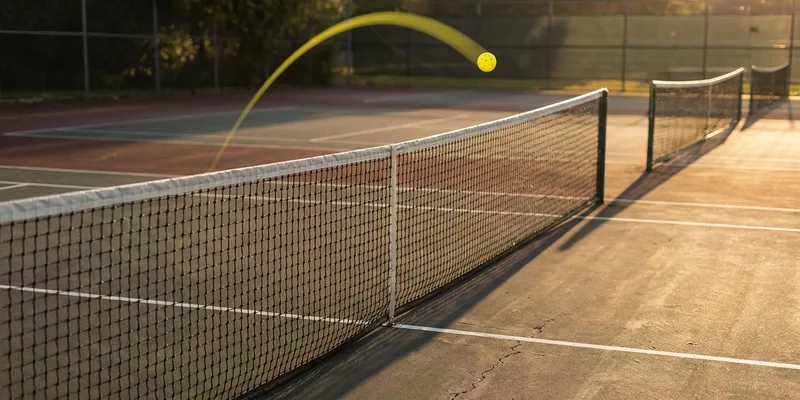
- Aim for a high, soft arc. The ball should climb well above the net and descend into the kitchen, landing with little forward bounce.
- Move forward as you hit. Start advancing toward the non-volley zone line the instant you make contact, not after you see where the ball lands.
Why the Two-Bounce Rule Makes This Shot Necessary
The two-bounce rule requires the serve to bounce before it is returned, and it requires that return to bounce as well before either team may volley it. In practice that means the serving team plays the third shot from at or near the baseline, well behind their opponents, who are typically already advancing toward the net.
A hard, flat third shot from that position is a gift to opponents standing at the kitchen line, since incoming pace is easy to redirect at close range. The third shot drop pickleball players rely on instead removes that pace, buying the serving team time to reach the net themselves before the next ball arrives. For the full sequence this shot sits inside, see our guide to how to serve in pickleball and the broader pickleball rules hub.
Third Shot Drop vs Third Shot Drive
The drop is not the only legal or common option on the third shot; the drive is its faster, flatter alternative. A third shot drive is hit with real pace, aimed low over the net, and it can pressure opponents directly or draw an error, especially against a team that has not yet reached the net themselves.
The tradeoff is risk. A drive that opponents are ready for can be redirected right back at the server, who is still out of position near the baseline. Many players mix both shots deliberately, using the drop as the reliable default and the drive as a change-up once a pattern has been established.
Practicing the Third Shot Drop Without a Partner
The shot rewards repetition more than any single tip can. A simple solo drill is to feed yourself balls from behind the baseline, alternating hands or dropping from a consistent height, and hit drop after drop toward a target zone marked in the kitchen with a towel or cone.
Tracking a simple make-versus-miss count over a set number of reps gives you a way to measure progress without needing a coach or a hitting partner. Consistency in landing zone matters more early on than trying to add disguise or variety to the shot.
Reading the Return Before You Choose
Not every third shot situation calls for the same answer. A deep, hard return that pushes you well behind the baseline usually favors a drop, since you need the extra time the shot buys to recover court position. A short or weak return that lands closer to the kitchen can open the door for a drive instead, since you are already closer to attacking range.
Reading your opponents’ position matters too. If both opponents are still moving toward the net rather than already set up there, a drive can catch them out of position before they are ready to defend it. Against opponents already planted at the kitchen line, the drop remains the steadier choice.
What a Good Drop Sets Up Next
A well-placed third shot drop does not win the point by itself; it earns the serving team a spot at the non-volley zone line on close to even terms. From there, the point usually shifts into the same soft, patient exchange described in our guide to the dink, rather than continuing as a power rally.
That shift is the entire strategic point of the shot. Teams that consistently land their third shot drop tend to win more points not because the drop itself is a winner, but because it lets them compete evenly once the rally reaches the net, where the two-bounce rule no longer favors either side.
Common Third Shot Drop Mistakes to Fix
- Hitting it too flat. A low, flat trajectory usually lands short of the kitchen or gives opponents an easy ball to attack out of the air once it clears the net.
- Standing still after contact. The whole point of the shot is to buy time to advance; staying at the baseline defeats that purpose even with a perfect drop.
- Guiding the ball instead of swinging through it. A tentative, poking motion is harder to control consistently than a smooth, complete swing with an open face.
- Aiming for a winner. The drop is meant to neutralize the point, not end it; forcing an aggressive angle usually increases errors instead.
- Skipping the drive entirely. Relying only on the drop makes your third shot predictable; mixing in an occasional drive keeps opponents honest.
Frequently Asked Questions
What is a third shot drop in pickleball, in one sentence? It is a soft, high-arcing shot hit by the serving team on the third shot of a rally, aimed to land in the opponent’s kitchen while the server advances toward the net.
Why is the third shot drop so important? The two-bounce rule puts the serving team at a positional disadvantage after the return, and a well-placed drop is the main way they neutralize that disadvantage and get to the net safely.
How do you hit a third shot drop in pickleball consistently? Use a low-to-high paddle path with an open face, contact the ball out in front of your body, and aim for a high, soft arc that lands short in the kitchen with minimal bounce.
Is the third shot drop technique the same as a dink? They are related but different. A dink is hit from near the net during a kitchen-line rally, while the third shot drop is hit from farther back to approach the net in the first place.
Should beginners learn the drop or the drive first? Most coaches recommend starting with the drop, since it is more forgiving and teaches the touch and arc that show up throughout the rest of the game.
Can you practice the third shot drop by yourself? Yes. Self-feeding drop shots toward a marked target zone in the kitchen is a common solo drill that builds consistency without needing a partner or a coach.
Does the third shot drop work the same in singles and doubles? The mechanics stay the same, but doubles gives the server a partner to help cover the net, while singles players have to close the distance and defend the whole court alone.
The Bottom Line
The third shot drop is the soft, arcing answer to a problem the two-bounce rule creates: the serving team starts the point behind the net while their opponents are usually already there. A good drop lands short and low in the kitchen and buys the server time to close that gap, while the third shot drive offers a faster, riskier alternative once the drop is reliable. Build the shot with slow, target-focused repetition before worrying about disguise or pace.