Last updated: August 18, 2026
Padel and pickleball get lumped together constantly, in casual conversation, in club marketing, and in plenty of search results that treat them as near-synonyms. They aren’t. The padel vs pickleball mix-up is understandable, both are paddle sports played on a smaller-than-tennis court with a low-compression ball, both exploded in popularity around the same years, and both get compared to tennis. Past that surface resemblance, they are genuinely different sports, with different courts, different equipment, and different rules.
This guide sets the record straight, category by category, so you know exactly which sport you’re being invited to play, and what to expect when you show up.
Quick Answer
What’s the actual difference between padel and pickleball?
- Padel is played on an enclosed court with glass and mesh walls that are part of live play; pickleball has no walls at all.
- Padel courts (20m x 10m) are more than four times the size of a pickleball court (44 ft x 20 ft), and padel is doubles-only, while pickleball offers both singles and doubles.
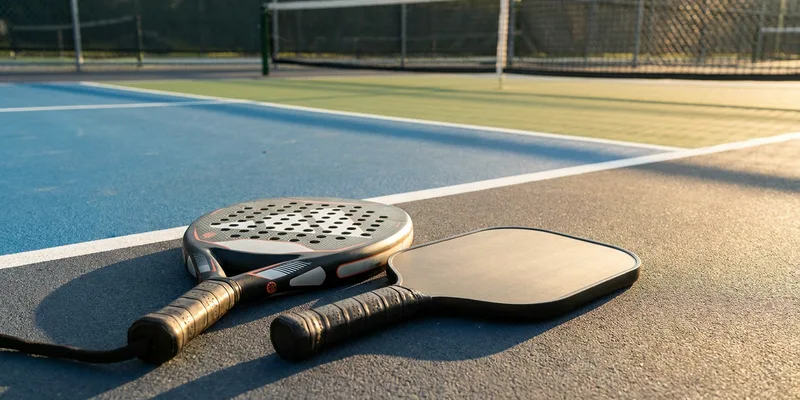
- The equipment differs too: padel uses a stringless racket with holes and a de-pressurized ball closer to a tennis ball, while pickleball uses a solid paddle and a hard plastic, hole-covered ball.
Bottom line: these are two separate sports that happen to share a family resemblance, not two names for the same game.
Padel vs Pickleball at a Glance
Use this table as the quick reference, then read the sections below for the reasoning behind each row. The walls are the single biggest structural difference, but they’re far from the only one.
| Category | Padel | Pickleball |
|---|---|---|
| Court | 20m x 10m (about 66 ft x 33 ft), enclosed by walls | 44 ft x 20 ft, open, no walls |
| Walls | Glass and mesh walls are part of live play | No walls; ball out of bounds ends the point |
| Players | Doubles only | Singles or doubles |
| Racket/paddle | Solid, stringless racket with holes, built for power | Solid paddle, no holes, built more for control |
| Ball | Similar to a tennis ball but less pressurized | Hard plastic ball with holes, wiffle-ball style |
| Serve | Underhand, below the waist, ball bounced first | Underhand, diagonal, below the waist |
| Scoring | Same as tennis (15/30/40/game, sets) | Points to 11 (win by 2), traditional serve-scores format |
Walls: The Difference That Changes Everything
Padel is built around its walls. The court is enclosed by glass and metal mesh, with back walls around 3 meters (about 9.8 feet) high and side walls that taper from 3 meters down to roughly 2 meters near the net. The ball is allowed to bounce off these walls during a rally, and using them well, angling a shot off the glass to wrong-foot an opponent, is a core padel skill, not a quirky exception.
Pickleball has no walls at all. It’s played on an open court, closer in spirit to badminton or tennis in that sense, and a ball that goes out of the court boundary simply ends the point. If you’ve only ever played pickleball, the idea of intentionally hitting a ball off a wall to keep a rally alive is the single biggest mental adjustment padel asks of you.
Court Size and Layout
A padel court measures 20 meters by 10 meters, roughly 66 feet by 33 feet, which makes it more than four times the playing area of a pickleball court at 44 feet by 20 feet. Padel courts also sit lower to the ground conceptually since the walls create a fully enclosed playing box, while a pickleball court is just painted lines on an open surface, frequently overlaid on an existing tennis or basketball court.
Padel is always played as doubles, four players split across two teams, and there’s no official singles format. Pickleball offers both singles and doubles, so the format question alone is one more way the two sports split apart before you’ve even picked up equipment.
Equipment: Two Different Toolkits
A padel racket is solid and stringless, like a pickleball paddle in that broad sense, but it’s typically made from carbon fiber or fiberglass and perforated with holes to cut air resistance, a design aimed at generating power and spin. A pickleball paddle is also solid and stringless, but it’s usually flat with no holes, built from composite or graphite materials, and shaped more around control and touch than raw pace.
The balls diverge just as sharply. A padel ball looks almost identical to a tennis ball, felt-covered and round, but it’s smaller and less pressurized to suit the enclosed court. A pickleball is a hard, hollow plastic ball covered in holes (commonly 26 or 40 of them), closer to a wiffle ball than anything used in padel or tennis. The two balls don’t behave alike in flight, off the walls (padel), or off the paddle face, and equipment genuinely isn’t interchangeable between the sports.
Serving and Scoring
Both sports use an underhand serve struck below the waist, which is one of the closer similarities between them. Padel’s serve additionally requires the ball to bounce once before you strike it, similar to a tennis serve toss but hit underarm, and it’s served diagonally into the opponent’s service box.
Scoring is where padel leans hard on its tennis roots: it uses the same love, 15, 30, 40, game structure, decided across sets, exactly like tennis. Pickleball scoring runs on a simpler point count, traditionally played to 11 points with a two-point win margin, and in the traditional format only the serving side can add to the score. Anyone who already knows tennis scoring will find padel’s system instantly familiar; pickleball’s system takes a few minutes to learn but is arguably simpler once it clicks.
Where Each Sport Is Easiest to Find
Padel has deep roots in Spain and Latin America and a large existing base of dedicated, walled courts in those regions, with newer growth in the United States concentrated in dedicated padel clubs since building a walled court is a bigger construction project than painting pickleball lines. Pickleball has spread faster across existing U.S. recreational infrastructure precisely because it needs so little: a flat 44-by-20-foot surface, a low net, and a set of lines is enough, which is part of why it’s become common at parks, gyms, and repurposed tennis courts nationwide.
That infrastructure gap matters if you’re deciding which sport to try first. Pickleball is very likely available nearby with minimal setup, while finding a padel court may mean seeking out a dedicated club, though that’s changing as padel’s popularity grows in the U.S.
Why the Two Get Confused So Often
Part of the mix-up is simple timing. Both sports saw a sharp rise in mainstream attention around the same recent years, both get described in headlines as “the fastest-growing racket sport,” and both are frequently pitched to the same audience: people looking for a lower-impact, social alternative to tennis. When two unfamiliar sports arrive in someone’s feed at once, with similar marketing language and similarly sized paddles, blending them into one mental category is an easy mistake to make.
The names themselves don’t help. Padel and pickleball share no linguistic root, padel comes from the Spanish word for the sport itself, while pickleball’s name traces to crew racing slang, but they sound similar enough in passing conversation that people often assume one is a regional nickname for the other. It isn’t; they’re separate sports with separate rulebooks, separate governing bodies, and separate equipment, and treating them as interchangeable is the fastest way to show up at the wrong court with the wrong gear.
Frequently Asked Questions
Is padel just pickleball with walls? No. Walls are the most visible difference, but padel also has a larger court, doubles-only format, different equipment, and tennis-style scoring, enough differences that it’s fair to call them separate sports rather than variants of one game.
Can a padel racket be used for pickleball, or the reverse? Not really. A padel racket is heavier and shaped for power against a tennis-style ball, while a pickleball paddle is built for a lighter plastic ball; using either in the other sport puts you at a real disadvantage.
Which sport is older, padel or pickleball? Padel was invented in 1969 in Acapulco, Mexico; pickleball was invented in 1965 on Bainbridge Island, Washington, so pickleball has a few years’ head start, though both trace back to the mid-to-late 1960s.
Is padel or pickleball more physically demanding? They load the body differently: padel’s larger court and use of walls involve more running and angle-chasing, while pickleball’s compact court favors quick reflexes and short lateral movement. Neither is inherently safer or harder; anyone with a joint concern should ask a doctor or physical therapist before starting either sport.
Do padel and pickleball use the same ball? No. Padel uses a smaller, less-pressurized version of a tennis ball, while pickleball uses a hard plastic ball covered in holes. They aren’t interchangeable between the two sports.
Is pickleball or padel easier to learn? Most beginners find pickleball’s rules and scoring quicker to pick up, since the court is smaller and the sport has fewer moving parts than padel’s wall play. Padel tends to reward players with a tennis background who already understand its scoring and serve.
The Bottom Line
Padel and pickleball share a family resemblance, small paddle-based courts and low-compression balls, but the padel vs pickleball comparison ends there. Padel is played on a much larger, wall-enclosed court exclusively as doubles, with tennis-style scoring and a racket built for power. Pickleball is played on a compact, open court in singles or doubles, with a simpler scoring system and a paddle built for touch. Knowing the difference before you show up saves you from bringing the wrong equipment, or the wrong expectations, to the court.