Last updated: August 18, 2026
Ask when was pickleball invented and you’ll usually get the same one-line answer: 1965, a backyard on an island near Seattle. That’s true, but it skips the more interesting part, which is who invented pickleball and why the game turned out the way it did. It wasn’t designed by a sporting goods company or a coach chasing a new format. It was three dads improvising a fix for bored kids on a summer afternoon, using whatever equipment happened to be lying around.
This is the real pickleball history, the founders, the accidental design choices that became permanent rules, the name and the myth attached to it, and how a backyard game turned into one of the fastest-growing sports in the country.
Quick Answer
When was pickleball invented, and who invented it?
- Pickleball was invented in the summer of 1965 on Bainbridge Island, Washington, by Joel Pritchard, Bill Bell, and Barney McCallum.
- The three men improvised the game on a badminton court using table tennis paddles and a perforated ball, then wrote a simple set of rules over the following weeks.
- The name most likely comes from crew racing’s “pickle boat,” a boat crewed by leftover rowers, not from a dog named Pickles, a popular but debunked legend.
Pickleball History Timeline
The table below lays out the key moments in order, from the first backyard game to the sport’s formal organization. Each milestone is covered in more detail in the sections that follow.
| Year | Milestone |
|---|---|
| Summer 1965 | Joel Pritchard, Bill Bell, and Barney McCallum improvise the first game on Bainbridge Island, Washington |
| 1965 (weeks after) | The three founders write the first rules and refine the paddles used |
| 1968 | Pickleball Inc. is incorporated to promote the new sport |
| Later decades | Regional clubs and tournaments form as the game spreads beyond the Pacific Northwest |
| Recent years | Pickleball is repeatedly named one of the fastest-growing sports in the United States by national participation surveys |
Who Invented Pickleball: Meet the Three Founders
The people who invented pickleball were Joel Pritchard, a Washington State legislator who later served in the U.S. House of Representatives, along with his friends Bill Bell and Barney McCallum. All three were neighbors and family friends on Bainbridge Island, an island community across the water from Seattle, and none of them set out to invent a sport. They were trying to solve a much smaller problem: entertaining bored kids during a summer weekend.
The three men are consistently credited as co-founders across historical accounts, including USA Pickleball’s own history pages and independent local history sources on Bainbridge Island. Pritchard is generally described as the one who pushed to formalize the rules, while McCallum is often credited with refining the paddle design in the game’s early years.
How the First Game Actually Happened
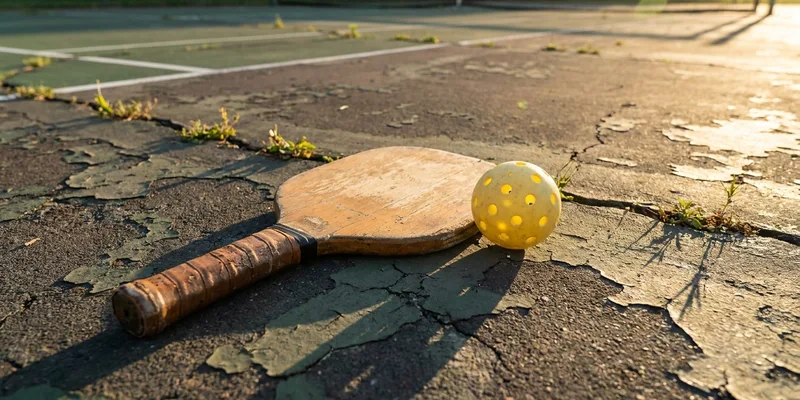
The founding story is specific enough to feel believable, because it is: on a summer afternoon in 1965, the Pritchard and Bell families found themselves with kids who had nothing to do and equipment scattered around the property. There was an old badminton court on site, but no full set of badminton rackets, so they grabbed table tennis paddles instead and improvised with a perforated plastic ball rather than a shuttlecock.
They lowered the badminton net to a height that made the game playable with paddles rather than rackets, and kept adjusting on the fly. What started as an afternoon’s entertainment worked well enough that the families kept playing, and over the following weeks Pritchard, Bell, and McCallum wrote down a basic set of rules so the game could be played consistently, borrowing ideas from badminton’s court shape and tennis’s general format while inventing new rules where neither sport quite fit.
From Backyard Game to Organized Sport
Pickleball stayed a regional, mostly Pacific Northwest activity for years before it began spreading more widely. The founders and early adopters incorporated Pickleball Inc. in 1968 to help promote the game formally, which marked the shift from a family pastime to something being deliberately organized and shared. From there, growth was gradual for decades before accelerating sharply in more recent years, helped by the game’s low equipment cost, its short learning curve, and how easily it fits onto existing courts.
Where the Name “Pickleball” Actually Comes From
Two origin stories circulate for the name, and only one holds up under scrutiny. The story with the strongest backing traces the name to “pickle boat,” a term from crew racing for a boat crewed by leftover rowers pulled together from other boats, a mismatched, thrown-together crew. Joel Pritchard’s wife, Joan, is generally credited with suggesting the name because the new game, like a pickle boat, was cobbled together from parts of other sports.
The competing story, that the sport was named after a family dog called Pickles who chased the ball, is a persistent and widely repeated legend, but the timeline doesn’t support it: by most accounts the dog was born around 1968, roughly three years after the game was already being played and named. In other words, the dog was very likely named after the sport, not the other way around, even though the dog story remains one of the most frequently repeated pieces of pickleball history online.
How the Rules Evolved Into What You See Today
Many of the pickleball rules still in use today trace directly back to decisions the founders made in that first summer. The non-volley zone near the net, now universally called the kitchen, grew out of early attempts to stop taller or more aggressive players from dominating simply by smashing the ball at the net. Lowering the badminton net became the standard pickleball net height still used on modern courts.
As the sport formalized, national governing bodies took over maintaining and updating the official rulebook, standardizing court dimensions, equipment specifications, and approved paddle materials for competitive play. If you want the current, formal version of those rules rather than the historical origin, our complete guide to pickleball rules covers what’s actually enforced on court today.
From Bainbridge Island to a National Sport
For much of its history, pickleball remained a modest, regional activity, popular in parts of the Pacific Northwest and among retirement communities that adopted it early for its gentler learning curve compared to tennis. That started changing meaningfully in the 2010s and accelerated further in recent years, with national sport participation surveys repeatedly naming pickleball among the fastest-growing sports in the United States.
The reasons for that growth line up closely with the same qualities that made the original backyard game work: it’s inexpensive to start, the court is small enough to fit almost anywhere, and the learning curve is shallow enough that a first-timer can rally within minutes. Six decades after three dads improvised a fix for a boring afternoon, that same accessibility is still the sport’s biggest selling point.
Why the Founding Story Still Matters
It would be easy to treat pickleball history as trivia, a fun fact to bring up between games. But the founding story explains real design choices you still run into on court today. The kitchen exists because early players noticed the game got lopsided when someone simply parked at the net and smashed every ball; the fix they improvised in 1965 is still the rule that shapes modern strategy. The court’s small size wasn’t chosen for any grand reason either, it’s simply the size of the badminton court the founders happened to have available, and it stuck because it worked.
That do-it-yourself origin is also part of why the sport has stayed so approachable. Pickleball wasn’t engineered by a committee trying to maximize spectacle or difficulty; it was built by people trying to keep a group of kids entertained for an afternoon, and that practical, low-barrier spirit carried through into how easy the game remains to start today, whether you’re picking it up at a local park or a family gathering of your own.
Frequently Asked Questions
When was pickleball invented? Pickleball was invented in the summer of 1965 on Bainbridge Island, Washington, by Joel Pritchard, Bill Bell, and Barney McCallum.
Who invented pickleball? Three Bainbridge Island neighbors, Joel Pritchard, Bill Bell, and Barney McCallum, are credited as co-founders after improvising the game on a badminton court in 1965.
Is pickleball named after a dog? Almost certainly not. The family dog named Pickles was reportedly born around 1968, years after the game was already being played and named, which points to the dog being named after the sport rather than the reverse.
Where was pickleball invented? On Bainbridge Island, Washington, at Joel Pritchard’s family property, using an old badminton court, table tennis paddles, and a perforated plastic ball.
Why is pickleball called pickleball? The most credited explanation ties the name to “pickle boat,” a crew racing term for a boat made up of leftover, mismatched rowers, reflecting how the new game was pieced together from parts of other sports.
How did pickleball become so popular? Growth stayed slow and regional for decades before accelerating sharply in recent years, driven by the sport’s low cost of entry, small court footprint, and a learning curve that’s noticeably shorter than tennis for most beginners.
The Bottom Line
Pickleball history starts with a specific, well-documented answer to both when was pickleball invented and who invented pickleball: summer 1965, on Bainbridge Island, Washington, by Joel Pritchard, Bill Bell, and Barney McCallum. What began as an improvised fix for bored kids, using badminton court, table tennis paddles, and a perforated ball, grew into a formally organized sport by 1968 and has since become one of the fastest-growing games in the country. The rules you play by today, right down to the kitchen and the net height, trace straight back to that first weekend.