Last updated: August 18, 2026
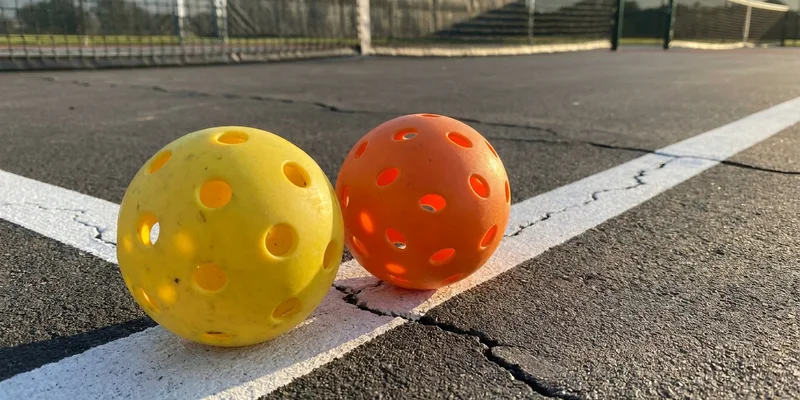
Two pickleballs sitting side by side look close enough to identical that most newcomers assume the labels are a marketing distinction. Then they take an indoor ball outside on a breezy afternoon, watch it drift sideways on a routine serve, and discover that the difference is not cosmetic at all.
Indoor and outdoor pickleballs are built for different air, different surfaces, and different playing speeds. This guide explains what physically differs between them, how each one behaves during a rally, and how to tell which ball is which when they are loose in the bottom of a bag with no packaging in sight.
Quick Answer
What is the difference between indoor and outdoor pickleball balls?
- Outdoor balls are made of harder, heavier plastic with more and smaller holes, so wind pushes them around less and they hold a truer flight outside.
- Indoor balls use a softer plastic with fewer and larger holes, which makes them slightly lighter, quieter, and easier to control on a smooth gym floor.
- The practical result: outdoor balls play faster and crack over time, indoor balls play softer and tend to go out of round instead.
Rule of thumb: count the holes. Fewer and larger means indoor, more and smaller means outdoor.
The Physical Differences at a Glance
The two ball types differ in three things: the plastic they are moulded from, the number and size of the holes, and how that combination distributes weight. Everything else about how they play follows from those three choices, which is why the differences show up immediately rather than subtly.
| Property | Indoor ball | Outdoor ball |
|---|---|---|
| Plastic | Softer, more flexible | Harder, more rigid |
| Holes | Fewer and larger, commonly 26 | More and smaller, commonly 40 |
| Weight feel | Slightly lighter in hand | Slightly heavier in hand |
| Typical surface | Wood or synthetic gym floor | Asphalt or concrete court |
| Sound on contact | Softer, lower pitched | Sharper, louder crack |
| How they fail | Go soft or out of round | Crack, usually at a seam or hole |
Why Outdoor Balls Are Built Harder
Wind is the entire reason. A lighter ball with large openings catches moving air and deviates from its intended line, which turns an outdoor serve into a lottery. Outdoor balls counter that with denser plastic and a larger number of small holes, giving them more mass and a more stable flight in a breeze.
That rigidity comes at a cost. Harder plastic played on abrasive asphalt in cold weather is more prone to cracking, which is why outdoor players carry spares as a matter of routine and treat a cracked ball as a normal consumable rather than a defect. Cold temperatures make brittle plastic more fragile still, which is why cracks cluster in winter play.
Why Indoor Balls Are Built Softer
Indoors there is no wind to fight, so the design priorities change to control, feel, and noise. A softer plastic with fewer, larger holes sits on the paddle face marginally longer, which many players describe as a more controllable ball for dinks and resets, and it produces a softer sound in a room with echoing walls.
Because the plastic is more flexible, indoor balls rarely crack. Instead they gradually deform, losing their true round shape and their bounce consistency, which is a slower and less obvious end of life than an audible crack. Players often keep using an indoor ball well past the point where it has gone slightly egg shaped.
How Each One Changes the Rally
Outdoor balls play faster off the paddle and skid more off a hard court, which shortens reaction time at the kitchen and rewards players who can reset a fast ball. Indoor balls travel a touch slower and sit up more on a smooth floor, which tends to produce longer dink exchanges and a more patient rhythm.
Spin behaves differently too. The harder outdoor surface and harder ball combine to bite more aggressively off a textured paddle face, while the softer indoor ball responds somewhat less dramatically to the same stroke. Switching between the two mid season is a common reason players suddenly feel their timing is off through no fault of technique.
The Court Surface Is Part of the Equation
It is easy to credit the ball for everything, but the surface it lands on does half the work. A gym floor returns a cleaner, more predictable bounce than weathered asphalt with a slight slope and a patch of grit, so the same ball behaves differently on two outdoor courts as well.
Telling Them Apart Without the Packaging
Count the holes. It is the quickest reliable test, since indoor balls commonly have around 26 larger holes and outdoor balls around 40 smaller ones. Colour is not a clue, because both types come in yellow, neon green, orange, and white depending on the manufacturer.
The squeeze test is the second check. An indoor ball gives noticeably under thumb pressure while an outdoor ball feels rigid, and dropping both on a hard floor produces an obvious difference in pitch. Between the hole count and the feel, you can sort a mixed bag in under a minute.
Which One Should You Buy
Buy for where you actually play most of the time. If you play primarily outdoors on asphalt, outdoor balls are the only sensible default, and if your play is entirely in a gym, indoor balls will feel better and last longer than an outdoor ball on that surface. Players who split their time typically keep a small supply of both.
One more consideration is what your group already uses, because a session runs on shared balls and turning up with the wrong type just means yours stays in the bag. Our guides to outdoor pickleball balls and indoor pickleball balls go through the specific models players buy most for each surface.
Frequently Asked Questions
Can I use an outdoor ball indoors? You can, and plenty of people do, but it plays faster and louder on a gym floor than an indoor ball, and the sharper sound is a genuine issue in shared indoor facilities.
Can I use an indoor ball outdoors? Only in still air. As soon as there is any wind, a lighter ball with larger holes drifts noticeably, which makes serving and dinking frustrating rather than merely different.
Why do outdoor balls crack so often? Harder plastic on abrasive surfaces takes repeated high speed impacts, and cold weather makes rigid plastic more brittle. Cracking is normal wear for the type rather than a sign of a bad batch.
Does ball colour mean anything? No. Colour is about visibility against a particular background and court surface, not about indoor or outdoor construction, so both types are sold in several colours.
Are approved balls different from recreational balls? Sanctioned play uses balls that meet the governing body’s equipment specifications, and the approved list is maintained by USA Pickleball at usapickleball.org. Recreational play has no such requirement, so casual sets often use unapproved balls.
How do I know when a ball is finished? An outdoor ball is done when it cracks or the bounce changes audibly. An indoor ball is done when it has visibly lost its round shape or feels soft, which is easier to miss.
The Bottom Line
Indoor and outdoor pickleballs are different products built for different air and different surfaces. Outdoor balls are harder and heavier with more small holes so wind affects them less, and they eventually crack. Indoor balls are softer and lighter with fewer large holes, play more quietly and controllably on a gym floor, and gradually go out of round instead. Match the ball to where you play, count the holes when you are unsure, and keep a couple of spares in the bag. If you are restocking, start with our guides to outdoor balls or indoor balls.