Last updated: August 18, 2026
Almost everyone who asks about pickleball court size is really asking one of two questions: how big does the game feel once you are standing on the court, or whether a court will fit in the space they already have. The painted rectangle is small enough that people underestimate it, and the space around that rectangle is large enough that people forget to count it at all.
This guide answers the size question in practical terms. It covers the playing surface, the run-off space that turns a painted rectangle into a usable court, how the footprint compares to a driveway, a backyard, a badminton court and a tennis court, and what to do when the space you have is smaller than the number on paper. All official figures come from the USA Pickleball rulebook, which the organization reviews at the start of each year.
Quick Answer
What size is a pickleball court?
- The playing surface is 20 feet wide by 44 feet long, about 880 square feet, and it is identical for singles and doubles.
- That is only the painted area. Court builders working from USA Pickleball guidance treat roughly 30 by 60 feet as the minimum total space, with 34 by 64 feet as a more comfortable recreational size.
- A pickleball court uses the same outer footprint as a doubles badminton court and takes up roughly a fifth of the area inside a tennis court fence.
Pickleball Court Size in Context
Numbers on their own rarely help anyone picture a court. The table below puts the official pickleball court size next to spaces most people can already visualize, so you can judge whether your driveway, gym floor or backyard is even in the running before you get out a tape measure.
| Space | Approximate footprint |
|---|---|
| Pickleball playing surface | 20 by 44 ft, about 880 sq ft |
| Minimum total space to build | 30 by 60 ft, about 1,800 sq ft |
| Comfortable recreational total | 34 by 64 ft, about 2,176 sq ft |
| Tournament-style total | 40 by 70 ft, about 2,800 sq ft |
| Doubles badminton court | 20 by 44 ft, the same outer rectangle |
| Tennis court playing surface | 36 by 78 ft, roughly three times the area |
| Typical two-car garage floor | Around 20 by 20 ft, far too short for a full court |
The Playing Surface: 20 by 44 Feet
A regulation pickleball court measures 20 feet across and 44 feet end to end, which works out to 880 square feet of playing surface. Split by the net, each side gets 20 by 22 feet, and the first 7 feet of that on each side is the non-volley zone. In everyday terms, one player is responsible for a space a little smaller than a single-car garage during doubles play, which is exactly why the sport is so approachable for people who find a tennis court exhausting to cover.
Those measurements refer to the outside edges of the lines, so the lines themselves are part of the court. That detail sounds pedantic until you are marking a surface yourself. The full line-by-line breakdown lives in our court dimensions in feet reference.
Why Singles and Doubles Use the Same Size
Pickleball uses one court size for every format. Singles, doubles, recreational play and sanctioned tournaments all happen inside the same 20 by 44 foot rectangle, with no alternate sidelines the way tennis has for singles. Nothing on the court changes when two players leave and two more arrive.
That single-size rule is one reason the sport spread so quickly through parks departments and community centers. A facility never has to choose which format a court is built for, and a group can switch between singles and doubles between games without moving a single line, net or post. What changes between the formats is the serving and positioning rulebook, not the surface underneath it.
The Space Around the Lines Is Part of the Size
The most common planning mistake is treating 20 by 44 feet as the amount of space a court needs. Players routinely chase balls several feet past the baseline and step well outside the sideline to return a wide shot, so a court squeezed into exactly its painted footprint puts fences, walls and furniture directly in the run-off path. Guidance built around USA Pickleball standards generally puts the practical minimum at 30 by 60 feet, with 34 by 64 feet recommended for comfortable recreational play and 40 by 70 feet for tournament conditions.
In practice that means the buffer is not a nice extra, it is roughly half the total area. A court laid out at 34 by 64 feet devotes about 880 square feet to the game and another 1,300 or so to the space that keeps play safe. When you are measuring a candidate space, measure to the nearest obstacle rather than to the property line, because a fence, a low wall, a light pole or a raised planting bed all count as the edge of what is usable.
Will a Court Fit in Your Backyard or Driveway?
Driveways
Residential driveways are usually the wrong shape rather than the wrong size. A two-car driveway is often somewhere around 18 to 20 feet wide, which is close to the court width but leaves nothing on the sides, and the length is frequently interrupted by a slope, a garage door or a sidewalk. Many households solve this by marking a shortened practice area with temporary tape instead of a full court, which works fine for dinking, serving and rally practice even though it is not regulation.
If the driveway is genuinely flat and long enough, the main additions are a portable net and a way to mark lines that does not permanently stain the concrete. Our pickleball net guide covers what separates a net that stays taut through a session from one that sags by the third game, which matters more on a home setup than most people expect.
Backyards
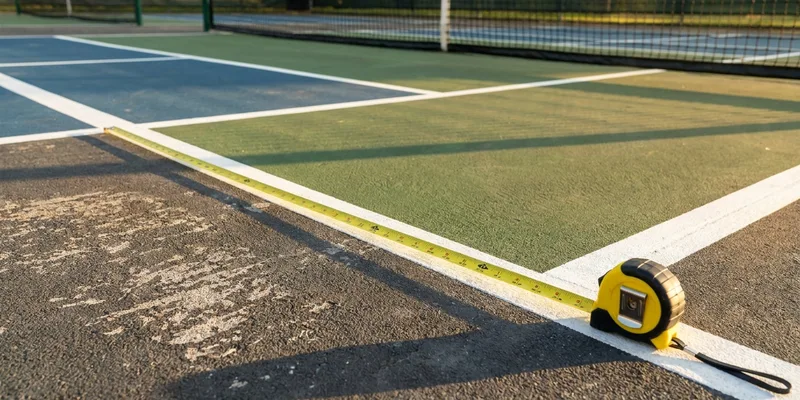
Backyards more often have the width but not the flat, hard surface. A grass court is playable for casual games, though the ball behaves very differently on turf than on asphalt, and the bounce becomes unpredictable as soon as the ground is uneven or damp. Before committing to a poured surface, walk the space with a tape measure and confirm you can reach at least 30 by 60 feet of clear, level ground including the buffer.
Slope matters as much as area. A surface that drains is essential outdoors, but a noticeable tilt changes how the ball moves, so settle the grading question before finalizing measurements.
How the Court Size Compares to Other Sports
A pickleball court shares its outer footprint with a doubles badminton court, which is not a coincidence: the sport was first played on a badminton court, and the dimensions stuck. That overlap is why school gyms can add pickleball to an existing floor with tape rather than a rebuild.
Against tennis the difference is dramatic. A tennis court’s 36 by 78 foot doubles surface is roughly three times the playing area, and the fenced area around it is usually large enough to hold two to four pickleball courts side by side, which is exactly how many conversions are laid out. The full comparison, including net height and what changes when a tennis court is converted, is covered in our pickleball court vs tennis court guide.
When the Space Is Smaller Than the Court
Plenty of people play useful pickleball in less than a full court. Serving practice needs length but almost no width, dinking practice needs a net and about 14 feet of depth, and wall drills need nothing but a flat vertical surface. Treating a partial space as a practice area rather than a failed court is usually the more productive way to think about it.
What does not work is shrinking the court proportionally and calling it a regulation game. The distances between the kitchen line, the baseline and the net are what make the two-bounce rule and the dinking exchanges function, so a scaled-down court plays like a different sport. If you want the real game at home and the space is close but not quite there, adjusting the buffer is a reasonable compromise; adjusting the 20 by 44 foot rectangle is not.
Frequently Asked Questions
How many square feet is a pickleball court? The playing surface is 880 square feet, and a court built with the recommended buffer typically occupies between 1,800 and 2,800 square feet depending on how much run-off space is included.
Is a pickleball court smaller than a tennis court? Yes, considerably. A tennis court’s doubles surface is 36 by 78 feet against pickleball’s 20 by 44, which is roughly three times the playing area.
Does the pickleball court size change for singles? No. Singles and doubles use the identical 20 by 44 foot court, unlike tennis where the singles sidelines sit inside the doubles lines.
Can I fit a pickleball court in a two-car garage? Not a full one. A typical two-car garage is around 20 feet deep, which is less than half the court length, though the width is often enough for kitchen-line drills.
How much clearance do I need behind the baseline? Court-building guidance generally puts total length at 60 to 70 feet against the 44-foot court, which leaves roughly 8 to 13 feet behind each baseline.
Is a pickleball court the same size as a badminton court? The outer rectangle matches a doubles badminton court at 20 by 44 feet, though the internal lines, the net height and the rules are all different.
The Bottom Line
Pickleball court size is two numbers, not one: 20 by 44 feet of playing surface, and roughly 30 by 60 feet of total space once you count the run-off room that makes the court safe to play on. Judge a candidate space against the second number, measure to the nearest obstacle rather than the property line, and treat anything smaller as a practice area rather than a shrunken court. For the exact position of every line inside that rectangle, our pickleball court dimensions guide takes it from here.