Last updated: August 18, 2026
Walk into almost any racquet facility built in the last thirty years and you will find pickleball lines painted over a tennis court. It is the cheapest way for a club to answer demand, and it works, but only if the person laying out the lines understands exactly how the two courts relate. The two footprints are not simple multiples of each other, and the net is the part that trips most people up.
This guide puts the two courts side by side in measured numbers, then works through what actually happens when you convert one into the other: how many pickleball courts genuinely fit, what the line layout looks like, why the tennis net cannot just be lowered, and what a shared-use court means for players of both sports.
Quick Answer
How does a pickleball court compare to a tennis court?
- A pickleball court is 20 by 44 feet, about 880 square feet, while a doubles tennis court is 36 by 78 feet, about 2,808 square feet, so a pickleball court covers a little under a third of the area.
- Counting the run-off space inside a typical tennis enclosure, four pickleball courts is the standard full conversion layout.
- The net is the catch: a pickleball net sits at 34 inches in the center and 36 inches at the sidelines, lower than a tennis net at every point, so a converted court almost always needs a portable net rather than an adjusted one.
Bottom line: the surface converts easily, the net does not, which is why line-only conversions rely on portable nets.
Pickleball Court vs Tennis Court in Numbers
Here is the measured comparison, using the USA Pickleball court specification and the standard tennis court dimensions. The rows below matter most for anyone planning a conversion.
| Measurement | Pickleball court | Tennis court |
|---|---|---|
| Playing lines | 20 ft x 44 ft, same for singles and doubles | 27 ft x 78 ft singles, 36 ft x 78 ft doubles |
| Playing area | 880 sq ft | 2,808 sq ft for doubles |
| Recommended total surface | 30 ft x 60 ft minimum, 34 ft x 64 ft preferred | Around 60 ft x 120 ft for a tournament-standard court |
| Baseline to net | 22 ft | 39 ft |
| Net height, sidelines or posts | 36 in | 42 in |
| Net height, center | 34 in | 36 in |
| Post spacing | 22 ft apart | 42 ft apart for doubles |
| Zone nearest the net | 7 ft non-volley zone each side | None |
How Many Pickleball Courts Actually Fit
The honest answer depends on whether you are measuring lines or fenced area. Inside the painted doubles lines of a tennis court, 36 by 78 feet, you cannot place two pickleball courts side by side, because two 20-foot widths need 40 feet before you add any separation. What fits within those lines is a single row of courts running across the tennis court, not the tidy four-court grid people picture.
The four-court figure comes from using the whole enclosure. A typical fenced tennis court occupies roughly 60 by 120 feet including run-off, and that area comfortably accommodates four pickleball courts in a two-by-two arrangement with room to move behind the baselines. That is the layout most conversion projects target, and it is why a club replacing one tennis court can suddenly serve four times as many players at once.
The Single-Court Overlay
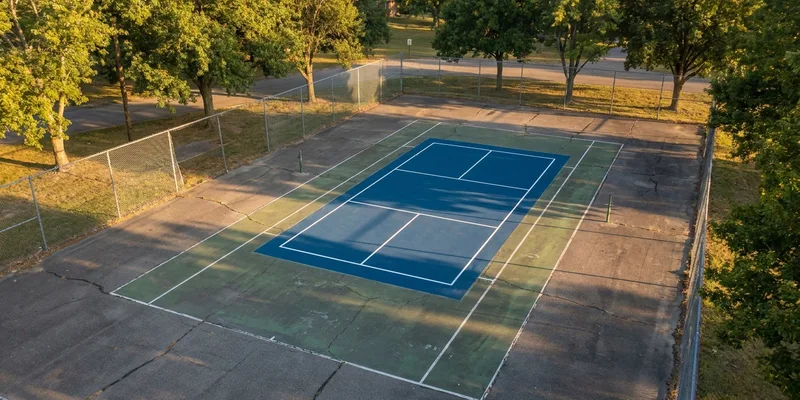
The simplest conversion is one pickleball court centered on an existing tennis court, sharing the tennis net line. It needs the least paint, keeps the tennis court usable, and works well for casual or family play. The drawback is that it uses a fraction of the available space, so most facilities with real demand skip straight to a multi-court layout.
Why the Net Is the Real Obstacle
Line paint is cheap and reversible. The net is neither. A tennis net measures 42 inches at the posts and 36 inches at the center, while a pickleball net measures 36 inches at the sidelines and 34 inches at the center. Every measuring point on a tennis net sits higher than the pickleball equivalent, so a tennis net set up as normal is too high for pickleball across its whole span.
The post spacing compounds it. Tennis doubles posts sit 42 feet apart, while a pickleball net spans 22 feet. Even if you could drop a tennis net to the right center height, the sideline height would be wrong because the net would still be stretched across nearly twice the distance. This is why the standard answer for a converted court is a portable pickleball net placed on the surface rather than any attempt to adjust the permanent tennis hardware.
Reading a Shared-Use Court
Blended lines are the usual compromise: pickleball lines are painted in a contrasting color over a fully lined tennis court, and both sports share the surface. It works, but it puts a lot of lines underfoot, and new players regularly hesitate over which line is the baseline and which is the tennis service line running through their court.
Two habits make shared courts easier. First, learn your own court’s outline before you play on one, particularly the kitchen line, which is the line that matters most and the one most likely to be confused with a tennis service line. Second, check the line color convention at the facility, since pickleball lines are typically painted in a distinctly different shade specifically so the two sets can be told apart at a glance. Our court dimensions guide covers the full layout if you want to memorize it before you arrive.
Surface and Play Differences That Remain
A converted tennis court plays differently from a purpose-built pickleball court in ways that have nothing to do with the lines. Tennis courts are usually built with a slightly different surface texture and, depending on the facility, a cushioned acrylic system tuned for tennis footwork rather than the short, repeated lateral steps pickleball demands. Neither is unsafe, but the feel is not identical.
Space behind the baseline is the more noticeable difference. A dedicated pickleball court is laid out with a defined run-off area, while a four-court conversion on a tennis footprint often leaves less room behind each baseline than players are used to. It is workable for recreational play and it is one of the recurring complaints when a facility packs the maximum number of courts into an enclosure.
What This Means if You Are Building at Home
If you are planning a court on your own property, plan around the total surface figure rather than the 20 by 44 foot playing lines. USA Pickleball’s recommended minimum of 30 by 60 feet, with 34 by 64 feet preferred, is what gives players room to chase a lob without running into a fence. Building to the line dimensions alone produces a court that measures correctly and plays cramped.
The comparison with tennis is useful here as a reality check: a pickleball court needs well under half the total footprint of a tennis court, which is exactly why residential pickleball courts are realistic on plots where a tennis court never was. It is also why a converted driveway or a sport-court slab is a common starting point rather than a full ground-up build.
Frequently Asked Questions
How many pickleball courts fit on one tennis court? Four is the standard figure when you use the full fenced area of around 60 by 120 feet. Within the painted tennis lines alone, the practical number is lower, since two 20-foot-wide courts do not fit across a 36-foot width.
Can you play pickleball on a tennis court without changing anything? You can rally, but not to the rules. The net is too high at every point and the service boxes are the wrong size, so you need pickleball lines and a pickleball-height net for a proper game.
Can a tennis net be lowered for pickleball? Not satisfactorily. Even at the correct center height the posts are 42 feet apart instead of 22, so the sideline height stays wrong. Portable nets are the normal solution.
Are pickleball lines on a tennis court confusing? They take some getting used to, which is why blended lines are usually painted in a contrasting color. The kitchen line is the one worth identifying first, since it is easily mistaken for a tennis service line.
Is a pickleball court the same size for singles and doubles? Yes, 20 by 44 feet in both formats, which is unlike tennis where the doubles alleys add 9 feet of width.
How much space do I need for a backyard pickleball court? Plan for the recommended total surface of at least 30 by 60 feet rather than the 20 by 44 foot playing lines, so there is run-off room behind the baselines and along the sides.
The Bottom Line
A pickleball court is 20 by 44 feet against a tennis court’s 36 by 78, so the surface math is friendly: four pickleball courts fit inside a standard fenced tennis enclosure, and one fits comfortably inside the tennis lines for a casual overlay. The net is where conversions get complicated, because a pickleball net is lower at every measuring point and spans half the distance between tennis posts, which puts portable nets at the center of nearly every conversion. Get the lines and the net right and a converted tennis court plays perfectly well, minus a little run-off room behind the baseline.