Last updated: August 18, 2026
Franklin is the paddle brand most Americans meet first, usually without going looking for it. It sits on the sporting goods aisle of the big box store, it comes inside the starter set someone brought to the family barbecue, and it is often the paddle in a community center’s loaner bin. That ubiquity shapes both the brand’s reputation and the question people actually have about it, which is whether a Franklin is good enough to keep playing with.
This guide covers what Franklin builds, where it genuinely competes, and where you would be better served by a specialist paddle brand. We do not test paddles ourselves. What follows is based on Franklin’s published product information and on what players consistently report about the brand’s paddles in practice.
Quick Answer
Is a Franklin pickleball paddle worth buying?
- For a first paddle, a loaner set, or a household that plays a few times a month, Franklin is one of the easiest and most available options there is.
- Franklin’s strength is breadth: starter sets, kids’ paddles, composite paddles, carbon-faced models, and the balls that go with them.
- Once you are playing weekly and chasing feel, the specialist paddle brands give you finer control over shape, thickness, and face texture.
Bottom line: Franklin is a strong way into the sport and a fine paddle for casual play, but it is not the place to shop if you are optimizing spin and touch.
Who Is Franklin and What Does the Brand Actually Make?
Franklin Sports is a long-established American sporting goods company that sells across many sports rather than specializing in pickleball alone. In pickleball it covers the whole entry layer of the market: paddles, balls, nets, and complete sets, distributed through mainstream retail rather than through specialist paddle shops.
The brand’s most cited pickleball product is not a paddle at all. Franklin lists its X-40 outdoor ball as the official ball of USA Pickleball, and that association does a lot of work for the brand’s credibility in a category where most buyers have no other reference point. Ball approvals and official designations are set by USA Pickleball and can change, so check the current designation at usapickleball.org if it matters to you.
Why Franklin Names Are Harder to Track Than Selkirk or JOOLA
Specialist brands keep a small number of named lines alive for years. Franklin runs a broader, faster-moving catalog with model names that rotate more often and vary by retailer, which means a name you see in one store may not exist in another. The practical consequence is to shop Franklin by paddle type and published specs rather than by chasing a specific model name you read about.
Which Franklin Paddle Fits Your Situation
Franklin’s range sorts more naturally by use case than by line name. The situations below cover the reasons most people end up with a Franklin, and each points at the type of product worth comparing.
Getting Two or Four People Playing This Weekend
The complete set is Franklin’s strongest offer, and it is genuinely the fastest route from deciding to try pickleball to actually playing. A typical set pairs paddles with balls and a carry bag, sometimes with a portable net. It is the low-commitment option for a household that is not yet sure how often it will play. Our pickleball set guide covers what a set should include before you buy one.

A Straightforward First Paddle for One Person
If you only need one paddle and want it to be uncomplicated, Franklin’s standalone composite paddles do the job. Expect a forgiving, wide-ish face and a mid-range weight rather than anything specialized, which is the right profile for someone still learning to track the ball. Before you buy, read our beginner paddle guide for the three specs that matter most on a first paddle.
Stepping Up Without Leaving the Brand
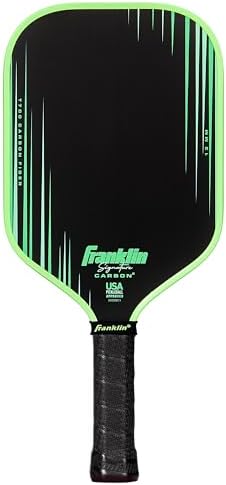
Franklin also sells paddles with carbon-faced construction aimed at players who have outgrown the entry tier but are not ready to spend at specialist-brand level. A textured carbon face is what generates spin on any paddle, so this is the tier where a Franklin starts to behave more like the paddles you see in competitive play. Our explainer on what a carbon fiber face actually changes is worth reading first.
Kids and Junior Players
Franklin’s retail reach makes it one of the easier brands to find in smaller, lighter paddles suitable for juniors. The number that matters here is grip circumference, not the age printed on the packaging. A grip that is too thick limits wrist movement on serves and dinks, and children’s hand sizes vary far more than a single junior label suggests.

Restocking Balls Alongside the Paddle
Balls are a consumable, not a one-time purchase. Outdoor balls crack in cold weather and go out of round with use, and most regular players go through them steadily. Since Franklin’s outdoor ball is the one most leagues and clubs recognize, buying a sleeve alongside a paddle is a reasonable default.

Where Franklin Fits Against the Specialist Brands
Franklin competes on availability, price, and breadth. Specialist paddle brands compete on construction, shape variety, and face texture. Neither is the better answer in the abstract; they are answers to different questions, and the honest comparison is about how much you play.
| You want | Franklin | Specialist brands |
|---|---|---|
| To start playing this week | Strong: sets, wide retail availability | Usually online only, single paddles |
| A paddle for occasional play | Fits well | More paddle than needed |
| Choice of shape and thickness | Limited | Their main selling point |
| Maximum spin and touch | Not the strength | Where they compete hardest |
| Kids’ and family gear | Strong | Rarely covered |
What to Check on a Franklin Listing
Read the same three numbers you would on any paddle: static weight, grip circumference, and grip length. Franklin’s retail listings sometimes bury these under lifestyle photography and set contents, so scroll to the specification block rather than judging from the product images. If a listing does not publish weight and grip circumference at all, treat that as a reason to look at another listing.
The face material is the fourth thing to identify. Composite and fiberglass faces are typically described as offering pop and a large sweet spot, while textured carbon faces are described around spin and a more consistent response. Both appear in Franklin’s range, and knowing which one is in the box tells you more about how the paddle will play than the model name does.
Set Contents Vary More Than You Expect
Two Franklin sets at the same apparent tier can contain different paddle constructions, different ball counts, and in some cases a net and in others not. Compare the actual contents list of the specific set, not the family name, since retailers carry different configurations of what looks like the same product.
Tournament Play and Approval
USA Pickleball’s approved paddle list at usapickleball.org lists individual models, not brands, and it is revised as equipment is tested and standards change. Franklin having an approved ball tells you nothing about whether a given Franklin paddle is currently on the paddle list.
If you plan to enter sanctioned events, look up the exact paddle model on the official list before buying. For recreational open play, no equipment enforcement applies and this is not a concern. Our overview of what USA Pickleball approval means explains the process.
Common Mistakes When Buying Franklin
The most common mistake is buying a four-paddle set when only two people will ever play. Sets are priced attractively per paddle, which makes the larger configuration feel like better value, but two unused paddles in a closet are not value. Count the actual players before choosing the set size.
The second mistake is expecting entry-tier Franklin paddles to behave like the carbon-faced paddles used in competitive play. They are built to a different price and a different purpose, and being disappointed by that is really a mismatch of expectations rather than a fault in the paddle. If spin and touch are what you are chasing, shop the carbon tier or move to a specialist brand.
Frequently Asked Questions
Are Franklin pickleball paddles good for beginners? Yes. Franklin’s entry paddles and sets are among the most accessible ways to start playing, and for a beginner the forgiving face and modest weight are more useful than advanced construction would be.
Is the Franklin X-40 the official pickleball of USA Pickleball? Franklin lists the X-40 as the official ball of USA Pickleball. Official designations are set by the governing body and can change, so confirm the current status at usapickleball.org.
Should I upgrade from a Franklin paddle? Consider it once you play weekly and start noticing that your drops and spin are limited by the paddle rather than by your technique. Before that point, an upgrade rarely changes results.
Do Franklin paddles come with a warranty? Coverage varies by product and retailer. Check the warranty statement on the specific listing and on Franklin’s own site rather than assuming a blanket policy.
What is the difference between a Franklin set and a single paddle? A set bundles paddles with balls and a carry bag, sometimes a net, at a lower per-paddle price. A single paddle lets you choose weight and grip more precisely, which matters more once you play regularly.
Are Franklin paddles allowed in tournaments? Only if the specific model appears on the USA Pickleball approved list. Search the model name on the official list rather than assuming brand-wide approval.
The Bottom Line
Franklin earns its place as the entry layer of pickleball, covering sets, singles, kids’ paddles, and the balls that most clubs already use. Shop it by paddle type and published specs rather than by model name, count your actual players before sizing a set, and step up to the carbon tier or a specialist brand when your technique starts outgrowing the paddle. If you are weighing Franklin against other brands, our framework for how to choose a pickleball paddle covers the specs that decide it.