Last updated: August 18, 2026
Set up a pickleball net with a tape measure in hand and you will notice something a tennis player might not expect: the net is not the same height all the way across. Pickleball net height is measured in two places, at the very center and at each sideline post, and the two numbers are different on purpose. Get either one wrong and you are not just off by a technicality, you are changing how the ball behaves right at the spot where most points are decided.
This guide gives you both official measurements, explains why the net sags lower in the middle instead of staying flat, and covers how to check and adjust your own net at home so it matches the same standard used in sanctioned play.
Quick Answer
What is the official pickleball net height?
- The net stands 36 inches (91.4 cm) tall at each sideline post and dips to 34 inches (86.4 cm) at the exact center.
- That 2-inch difference is intentional and is held in place by a center strap that pulls the net down slightly in the middle.
- USA Pickleball updates its rulebook every year, so always check the current edition before a sanctioned event; the height itself has been consistent across recent years.
Pickleball Net Height by Location
The table below is the entire net height rule in two rows. Everything else in this guide explains why it works this way and how to set it up correctly.
| Location | Inches | Centimeters |
|---|---|---|
| At each sideline post | 36 in | 91.4 cm |
| At the center of the net | 34 in | 86.4 cm |
| Difference (center strap sag) | 2 in | 5.1 cm |
| Net length, post to post | 22 ft | 6.71 m |
Why the Net Is Higher at the Posts Than in the Middle
A net that measured the same height everywhere would need to be pulled drum-tight from post to post, which is difficult to build and even harder to keep consistent over an outdoor season of sun, wind, and temperature swings. Instead, the official design uses a center strap, a fitting anchored to the ground or the net’s own frame at the midpoint, that pulls the net down to the correct 34-inch height right where it matters most.
That small sag has a real effect on play. The center of the court, right around the kitchen line, is where a huge share of points are decided, and a net that dips slightly there gives players a fraction more room to clear the tape on a low, aggressive shot through the middle than they would have if the net stayed at a full 36 inches across its entire width. It is a small detail with an outsized influence on how rallies unfold.
How to Measure and Set Up Your Net Correctly
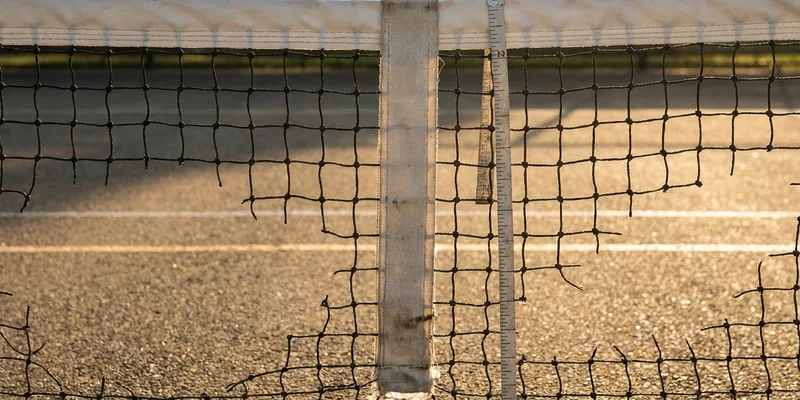
Checking your net height takes about a minute with a standard tape measure. Measure straight up from the court surface to the top of the net tape, first at the very center where the net is lowest, then out at each post where it is highest. If the center reads above 34 inches, the net is too tight or the center strap needs to be tightened further; if the posts read below 36 inches, the net is likely sagging overall and needs the side tension adjusted.
Most portable nets sold for driveways and backyards include a center strap for exactly this reason, so check that yours is actually clipped and pulled snug before you start measuring, since a missing or loose strap is the most common cause of an out-of-spec home setup. If you are still deciding between net styles for a home court, our guide to the full court and net layout covers how the net fits into the rest of the measurements.
What Happens If the Net Height Is Off
A net set too high across the board makes it noticeably harder to hit aggressive, low shots that clear the tape near the middle of the court, since even a slightly higher net closes that small window. A net set too low does the opposite, making it easier to drive shots through that a properly tensioned net would catch, which changes the balance of the game toward power and away from the softer, patient shots pickleball is built around.
For casual backyard play, being off by half an inch will not ruin your afternoon. For anyone practicing shots they intend to use in league or tournament play, though, training on a net that does not match the regulation 34-and-36-inch spread means practicing timing that will not transfer cleanly to a correctly set net on match day.
Pickleball Net Height vs Tennis: A Quick Comparison
Players coming from tennis sometimes assume the nets are similar, but pickleball nets sit noticeably lower. A tennis net measures 3 feet (36 inches) at the posts and drops to 3 feet at the center only where the strap holds it down further to a lower height than pickleball’s center measurement, and the two sports use different court sizes entirely. The practical takeaway is simple: do not reuse a tennis net setup and assume it is correct for pickleball without checking both measurements yourself, and see our pickleball vs tennis guide for the rest of the differences between the two games.
Do All Pickleball Nets Meet This Standard?
Not automatically. The 36-inch post height and 34-inch center height describe the official target, but any given net only meets it if it is set up and tensioned correctly, and not every product on the market is built with the same precision. Portable driveway nets, the kind that fold down into a wheeled bag, are generally reported to need more frequent adjustment than permanent, in-ground posts, since the lighter frame and ground stakes can shift slightly over a session of hard play.
Net age matters too. A net that has spent a season outdoors can stretch, and a stretched net tends to sag below the intended pickleball net height at the posts even when the center strap is still doing its job correctly at the middle. Checking the post height, not just the center, catches this kind of gradual drift that a quick glance at the middle of the net would miss entirely.
Setting Up a Home Net to Match Regulation Height
For anyone practicing at home with a portable net, the goal is simple: match the same 36-inch post and 34-inch center measurements used in sanctioned play, so the timing you build in practice carries over to a regulation setup elsewhere. Start by leveling the ground or driveway surface as much as possible, since even a slight slope changes the reading at one post compared to the other. Extend the frame fully, attach the center strap, and only then take your measurements, adjusting the side tension first and the strap second until both readings match the standard.
Recheck the height periodically rather than assuming a single correct setup stays correct all season. Wind, repeated impacts from the ball, and simply folding and unfolding a portable net dozens of times can all nudge the tension enough to matter over weeks of regular use.
Frequently Asked Questions
What is the pickleball net height at the center? The net measures 34 inches (86.4 cm) at the exact center, where a center strap holds it lower than the posts.
What is the pickleball net height at the sidelines? The net stands 36 inches (91.4 cm) tall at each sideline post, 2 inches higher than the center measurement.
Why does a pickleball net sag in the middle? A center strap intentionally pulls the net down to 34 inches at the midpoint, which is the standard design across regulation nets rather than a sign of a poorly set up net.
Is the pickleball net the same height as a tennis net? No. Pickleball nets sit lower overall than tennis nets, and the two sports measure their center height differently, so equipment should not be shared between them without adjustment.
Do indoor and outdoor pickleball nets use different heights? No. The 36-inch post height and 34-inch center height apply to indoor and outdoor play alike; only the ball and, in some cases, the court surface differ between the two settings.
How do I know if my portable net is set correctly? Measure at the center and at both posts with a tape measure. If the center reads 34 inches and the posts read 36 inches, your net matches the official standard.
The Bottom Line
Pickleball net height is 36 inches at the posts and 34 inches at the center, held in place by a center strap that creates the 2-inch dip on purpose. Measure both points, not just one, and adjust the strap rather than the overall net tension if your center reading is off. Once your net matches this standard, the rest of the court comes together; see our pickleball court dimensions guide for every other measurement you need.