
Last updated: August 18, 2026
The word regulation gets printed on a lot of net boxes, and nobody at the store is checking. It is not a certification, it is a marketing claim, which is why two nets sold under the same phrase can differ by a foot in width and by two inches in height once they are standing on your driveway.
This guide is about buying a net that genuinely matches the official playing dimensions: what those numbers are, which types of net reach them, and the three things on a product listing that tell you whether a seller is describing a real court net or a backyard approximation.
Quick Answer
What makes a pickleball net regulation?
- Posts set 22 feet apart, with the net spanning the full width between them.
- 36 inches high at the sidelines and 34 inches at the center, with a center strap creating that dip.
- A frame that holds those numbers under tension rather than only in the product photo.
- Anything narrower or without a center strap is a recreational net, whatever the box says.
Bottom line: check post spacing and the center strap first. Those two details eliminate most of the pretenders.
What Regulation Actually Means on a Net Listing
Regulation means the net matches the equipment specifications in the USA Pickleball rulebook. No agency inspects consumer nets, so the label is a description the seller chose to apply, and it carries weight only when the listing also states the measurements that back it up.
The practical consequence is that you verify rather than trust. A listing that gives post spacing, both heights, and confirms a center strap is telling you something. A listing that only says regulation size in the title is telling you nothing at all.
Why Sellers Get Away With It
Most buyers never measure. A net that plays roughly right in a driveway satisfies almost everyone, so the incentive to build to exact dimensions is weak at the budget end of the market. That is fine for casual play and a genuine problem if you are practicing shots you intend to hit at a club.
The Measurements a Net Has to Hit
USA Pickleball’s rulebook sets the standard: net posts placed 22 feet apart measured on the inside, the net 36 inches high at the sidelines and 34 inches high at the center, with a center strap pulling the middle down to that lower height. The court itself is 20 by 44 feet.
Those numbers are stable in practice, but the rulebook is revised annually, so confirm current equipment specifications at usapickleball.org if exact compliance matters for your court. Our net height guide covers how to measure yours correctly once it is standing.
The Center Strap Does the Real Work
The two inch difference between the sidelines and the middle is not something a frame produces on its own. It comes from a strap pulling the net down at the center. Without one, the middle settles wherever mesh tension happens to leave it, and that height drifts as the netting stretches over a season.
Regulation Nets by Situation
A Permanent Court in a Backyard or Community Space
For a court that stays put, in ground or sleeved posts with a tensioned net are the closest thing to a club setup. They hold height indefinitely, survive weather, and remove the whole question of whether the frame is sagging, which is why every serious home court ends up here.

Full Size Play Without Digging Anything In
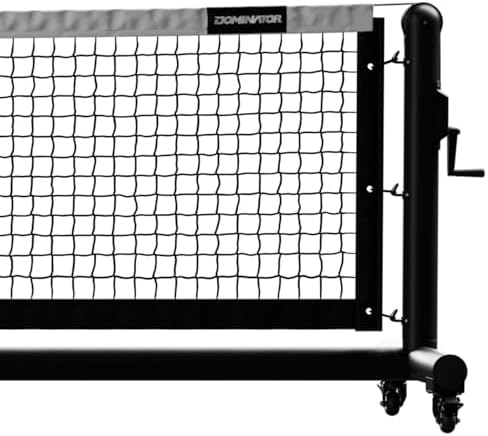
A regulation sized portable system gives you the correct 22 foot span and both heights on a frame that folds away. It is heavier and slower to assemble than a travel net, and that weight is exactly what keeps the geometry honest under tension.

Carrying a Full Size Net to a Park Court
Lightweight systems built around aluminum frames now reach full playing measurements while staying carryable by one person. Our SwiftNet 2.1 review covers the best known example and where the light frame costs you stability.
Replacing a Net That Has Stretched Out
Frames outlast netting by years. If your posts are fine and the mesh has gone slack or frayed at the tape, a replacement net panel restores correct height for a fraction of the cost of a new system, provided your post spacing is standard.

Fixing the Height on a Net You Already Own
If your net sits high in the middle, the missing piece is usually the center strap rather than the whole net. Aftermarket straps and tension adjusters solve a sagging or bulging middle without replacing anything else on the court.

Comparing Regulation Net Types
All four options below can reach official measurements. What separates them is how reliably they hold those numbers over a season and how much effort they demand from you each time you play.
| Type | Holds height | Effort | Best for |
|---|---|---|---|
| Permanent posts | Excellent | One time installation | Dedicated home or club courts |
| Regulation portable | Very good | Moderate setup | Driveways and shared spaces |
| Lightweight full size | Good in shelter | Fast setup, easy carry | Park courts and travel |
| Budget recreational | Drifts over time | Fastest | Casual play, not real practice |
How to Read a Listing Before You Buy
Three details separate a real court net from a recreational one, and all three are usually visible without contacting the seller. Look for a stated post to post span, both heights quoted separately, and explicit mention of a center strap. Missing any of the three is a reason to keep scrolling.
Photographs help more than they should. A net standing with a straight top line and no visible dip in the middle is either missing its strap or was photographed before anyone tensioned it, and either way you are looking at how the product will actually arrive.
Watch the Multi Sport Bundles
Nets that adjust to badminton and tennis heights sound like value and rarely are. A frame designed to serve three sports compromises on all of them, and the adjustable height mechanism is usually the first thing to slip once the net has been up for a few weeks.
Mistakes to Avoid When Buying a Regulation Net
The most expensive mistake is buying on the word regulation alone and discovering the span is narrower than 22 feet after the court lines are already down. Width errors are not fixable, and a narrow net quietly changes where the sidelines meet the play.
The second is treating height as a one time setting. Mesh stretches, straps loosen, and frames settle, so a net that measured correctly in April will not necessarily measure correctly in July unless someone checks it.
Buying More Net Than the Space Allows
A regulation net needs a regulation surface around it to be worth having. The playing area is 20 by 44 feet, and a comfortable court needs meaningful run off space beyond that. Our guide to court dimensions covers the total footprint before you commit.
What Gets Checked in Club and Tournament Play
At sanctioned events, net height is verified with a measuring device at the center and adjusted before play. In club and open recreational play, nobody measures anything, and courts routinely run slightly off without a single player noticing during a game.
That is the honest case for buying a proper net at home. Practicing dinks and drops over a net that sits two inches wrong builds a stroke calibrated to the wrong target, and the correction shows up at the worst possible moment. Our full pickleball net guide compares permanent and portable systems if you are still choosing between them.
Frequently Asked Questions
What size is a regulation pickleball net? Posts sit 22 feet apart, the net stands 36 inches high at the sidelines and 34 inches at the center, and a center strap creates that difference. The court beneath it measures 20 by 44 feet.
Is a portable net ever regulation? Yes. Several portable systems are built to full playing measurements, though many budget models are not. Check the stated post spacing rather than assuming the whole category matches.
Do I need a center strap? For correct height, yes. The two inch dip in the middle is created by the strap, and a net without one holds whatever height mesh tension happens to produce.
Can I use a tennis net for pickleball? Not properly. A tennis net is far wider and stands higher, so the geometry is wrong even if you play across it. Portable pickleball nets exist precisely to solve this on converted courts.
How do I know if my net is the right height? Measure at the center and at both sidelines with a tape or a net measuring device, after the net is fully tensioned. Our height guide walks through it step by step.
Does USA Pickleball certify nets? The rulebook specifies equipment dimensions, and manufacturers state whether their product meets them. Confirm current specifications at usapickleball.org, since the rulebook is revised annually.
The Bottom Line
A regulation pickleball net is defined by three details: 22 feet between posts, 36 inches at the sidelines, and 34 inches at the center held by a center strap. Permanent posts hold those numbers best, regulation portables come close, and lightweight full size systems trade some stability for portability. Verify the span and the strap on the listing rather than trusting the word regulation, then measure your net after setup using our height guide.