Last updated: August 18, 2026
CRBN made its name on one idea executed narrowly: raw carbon fiber faces built for spin, sold in a small number of clearly numbered shapes. Where mainstream brands cover every price point and every accessory, CRBN put its energy into paddles that competitive players would pick up voluntarily, and the brand’s reputation in control-oriented circles followed from that.
The upside for a buyer is that the lineup is unusually easy to read. The shape number tells you almost everything you need to know before you look at anything else. This guide explains that numbering, what a raw carbon face actually buys you, and who should skip CRBN entirely. We do not test paddles ourselves; this rests on CRBN’s published specifications and on what players consistently report.
Quick Answer
Which CRBN pickleball paddle should you buy?
- The shape number is the decision: 1 is the wide-body, 2 sits in between, 3 is the elongated shape.
- Most CRBN models are offered in more than one core thickness, and the thicker option is the softer, more forgiving one.
- CRBN is built around spin and control, so a player who mainly wants raw pop should look elsewhere first.
Bottom line: choose the CRBN shape that matches where you play your points, then use core thickness to fine-tune how soft or direct the paddle feels.
Who Is CRBN and What Is the Brand Known For?
CRBN is a paddle-focused company that built its following on raw, textured carbon fiber faces at a time when most mainstream paddles used painted or coated surfaces. Selling largely direct to players rather than through big box retail, it grew through word of mouth in competitive and club circles rather than through shelf presence.
What players consistently talk about is the face texture and the resulting spin, plus a soft, muted feel on touch shots. That combination is why the brand shows up so often in the hands of players whose game is built on dinks, resets, and third shot drops rather than on overpowering opponents from the baseline.
Why the Numbering Is Easier Than Most Brands
CRBN uses shape numbers instead of invented line names, which removes most of the guesswork that makes other catalogs confusing. Generation markers and series names sit on top of the number, but the number itself always tells you the shape family. Read the number first and the rest of the model string second.
Choosing a CRBN Shape
The three shapes cover a familiar spread from forgiving to reach-oriented. Almost every CRBN buying decision comes down to picking the right one of these, and the situations below explain which is which.
Maximum Forgiveness at the Kitchen: The Wide-Body
The wide-body shape gives the broadest face and therefore the most usable area on off-center contact. Players who spend most of their points in hands battles at the non-volley zone tend to prefer this, because a fast exchange rarely leaves time to find the center of the face. If you play a lot of doubles and value quick reactions over reach, start here.

The Middle Ground Most Players Land On
The middle shape trades a little face width for a little length, which for many players is the sweet spot between forgiveness and reach. It is the least specialized of the three and consequently the safest choice if you are buying your first CRBN and are not certain which way your game leans.

Reach and Leverage: The Elongated Shape
The elongated shape gives you extra reach on the stretch and more leverage through a full swing, at the cost of a narrower face. Players coming from tennis usually adapt to it quickly because the swing mechanics feel familiar. Players who mishit toward the edges will feel the narrower face immediately, so it rewards clean contact.

Buying Into the Brand Generally
If you are shopping CRBN as a brand rather than committing to a shape, compare current models side by side and pay attention to which generation each listing is. Superseded generations often stay on sale alongside current ones, and while that can be a genuine bargain, you want to know which one is in the box before you buy.
Protecting a Raw Carbon Face
A raw carbon face is the part of the paddle you are actually paying for, and it is also the part that suffers from being tossed in a bag against keys, water bottles, and other paddles. A cover is a small purchase that protects the surface that generates your spin. Our pickleball bag guide covers how to pack paddles so faces do not rub against each other.

CRBN Shapes Side by Side
The table summarizes the character of each shape family. Confirm current length, width, weight, and grip circumference on CRBN’s own product page, since exact figures vary by model and generation.
| Shape | Face profile | Leans toward | Suits |
|---|---|---|---|
| Wide-body | Widest, shortest | Forgiveness, hand speed | Kitchen-line doubles players |
| Hybrid | In between | Balance | Most players, first CRBN |
| Elongated | Narrowest, longest | Reach and leverage | Tennis converts, singles players |
What a Raw Carbon Face Actually Does
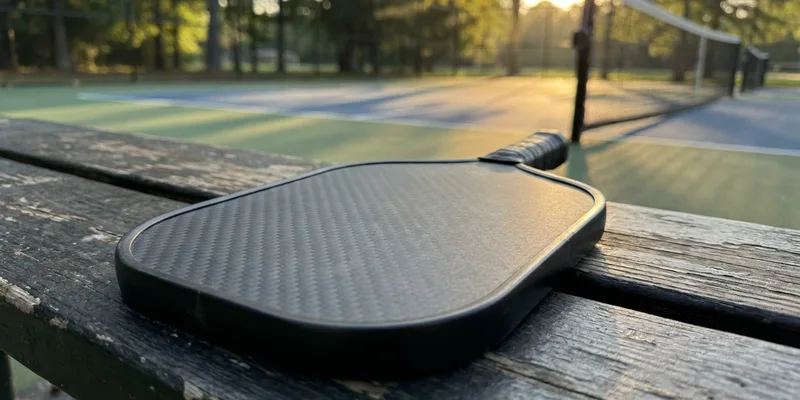
A raw carbon fiber face is left textured rather than painted or clear-coated, and that exposed texture is what grips the ball long enough to impart spin. Manufacturers describe raw carbon as delivering more bite and a softer, more muted feel than a glossier composite face, which translates on court into more spin on drives and more dwell on soft shots.
The trade is durability of that texture. Every textured face wears smoother with use, and a raw surface that starts grippier has further to fall. Players who play several times a week generally accept a shorter useful spin life as the price of the feel. Our guide to what carbon fiber changes in a paddle goes further into the material itself.
Core Thickness Is the Second Lever
CRBN offers models in more than one core thickness, and that choice moves the paddle more than most buyers expect. Thicker cores are generally described as softer and more forgiving with a bigger usable face, while thinner cores are described as more direct and more powerful. If a shape feels almost right but not quite, changing thickness within the same shape is usually the better fix than changing shape.
Tournament Approval Applies Per Model
USA Pickleball lists individual paddle models on its approved list at usapickleball.org, and approval attaches to a specific model and generation rather than to a brand. Standards and the list itself are revised over time, and paddles from many manufacturers have been added and removed across seasons.
If you compete in sanctioned events, look up the full model name on the official list before buying and check again ahead of each season. Recreational open play carries no equipment enforcement. Our explainer on USA Pickleball approved paddles covers how to read the list.
Common Mistakes When Buying a CRBN
The most common mistake is buying CRBN for power. The brand’s reputation is built on spin and a soft, controlled feel, and a player who wants to end points with pace may find the response quieter than expected. If raw put-away power is your priority, look at paddles positioned around power first, then decide whether you want to give some of it up for touch.
The second mistake is buying an elongated shape because it looks like what pros use, without accounting for where you actually play your points. Reach is genuinely useful in singles and on the stretch, and genuinely costly during a fast doubles exchange at the kitchen. Match the shape to your game, not to the highlight reel.
Frequently Asked Questions
What is the difference between CRBN 1, 2, and 3? They are shape families rather than quality tiers. The lower number is the wide-body with the most forgiving face, the middle is the hybrid, and the higher number is the elongated shape built for reach.
Is a CRBN paddle good for beginners? It can be, in a wide-body shape and a thicker core, but the brand is priced and built for players who already know they want spin and control. A beginner is usually better served spending less on a first paddle.
Why do CRBN paddles feel softer than other paddles? Players commonly describe the raw carbon face and core construction as producing a muted, dwelling feel on contact, which favors touch shots over immediate pop.
Does the raw carbon face wear out? The texture that generates spin smooths with use on every brand, and a raw face that starts grippier has more to lose. Expect the spin ceiling to drop over the paddle’s life, which is normal rather than a defect.
Are CRBN paddles approved by USA Pickleball? Approval applies to specific models and generations, not to the brand. Search the exact model on the official list at usapickleball.org, which is revised over time.
Which core thickness should I choose? Thicker for a softer, more forgiving feel and a larger usable face; thinner for a more direct, more powerful response. Start thicker if you are unsure, since forgiveness is easier to enjoy than to miss.
The Bottom Line
CRBN is one of the easiest paddle brands to shop because the shape number does most of the explaining: wide-body for forgiveness, hybrid for balance, elongated for reach. Choose the shape that matches where your points are won, use core thickness to fine-tune the feel, and accept that a raw carbon face trades long-term texture for spin. If you are still deciding between brands rather than between CRBN shapes, start with our framework for how to choose a pickleball paddle.