Last updated: August 18, 2026
The fastest way to improve at pickleball is more repetitions, and the hardest thing to find is a partner who wants to feed you two hundred dinks. A rebounder solves that. It gives the ball back, over and over, in a driveway or a garage, without booking a court.
The category covers several genuinely different products, though. This guide separates rebound nets from rigid boards and tethered trainers, explains what to look for in a frame you will drag out of a garage twice a week, and is honest about the drills it cannot help with.
Quick Answer
Which pickleball rebounder should you get?
- An angle adjustable rebound net is the most versatile choice and the one most players should start with.
- A rigid board or panel gives the most realistic, wall like bounce and suits fast hands and volley work.
- A tethered trainer with the ball on an elastic cord is the cheapest option and the most limited.
- Judge frames on stability and how quickly they set up, since a rebounder you dread assembling never gets used.
Bottom line: buy the one that matches your space and gets set up in under a minute, because frequency beats features.
What a Rebounder Gives You That a Wall Does Not
A flat wall is a fine practice tool and costs nothing, so it is worth being clear about what you gain by buying something. The answer is control over the return: angle, height and pace. A wall gives you the trajectory physics dictates, while an adjustable rebounder lets you set the return you want to practise against.
The second gain is portability. Most players do not have a suitable wall with a clear run up and a floor that is not somebody’s flower bed. A rebounder turns any flat surface into a practice station and folds away afterwards.
Where a Wall Still Wins
If you have access to a genuine practice wall at a court, use it. Nothing matches a solid surface for hands speed and reaction work, and it needs no setup. A rebounder is what you buy when that wall does not exist or is always occupied.
The Main Types Explained
Products sold as pickleball rebounders fall into three families, and they are not interchangeable. The differences are in how the ball comes back, how much space they need, and how much of the game they can actually simulate.
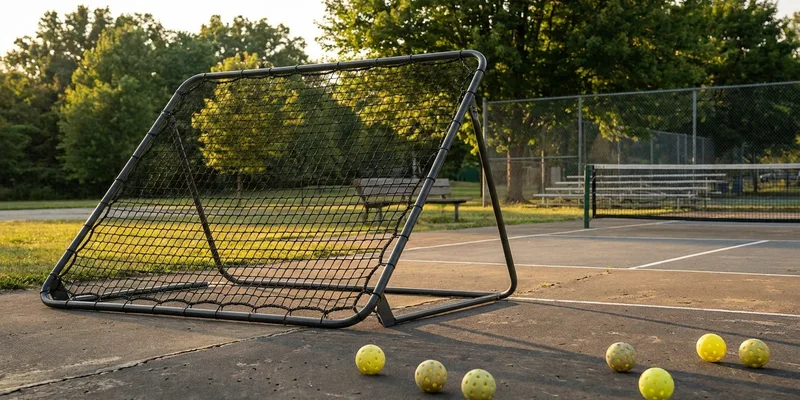
Rebound nets suspend a tensioned mesh in a frame, usually on bungee cords, and return the ball with some of the pace absorbed. Rigid boards use a solid surface and return the ball closer to full pace. Tethered trainers attach the ball to an elastic cord on a base, so it comes back to roughly the same place every time.
Rebound Nets
The most common type and the most adaptable. The frame usually tilts, so you can set it upright for volleys or angled back for a higher, softer return that suits dinks and resets. Because the mesh absorbs energy, returns are gentler than a wall, which makes them easier for newer players and less useful for pure reaction speed.
Rigid Boards and Panels
A solid rebound surface behaves much more like a wall: the ball comes back quickly and predictably, which is what you want for volley exchanges. They are typically heavier, less adjustable and noticeably louder, which matters in a garage attached to a house where other people live.
Tethered Ball Trainers
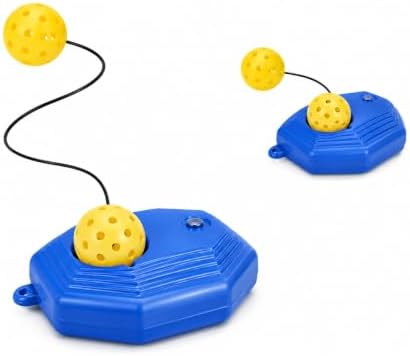
The ball sits on an elastic cord on a weighted base, so it returns to you regardless of where you hit it. That makes them forgiving and compact, and it is also their limitation: the flight is not a real ball flight. They work as a warm up or a beginner’s contact drill, not as a substitute for a rebound surface.
What to Look For Before You Buy
Four things decide whether a rebounder gets used: how stable it is, how fast it sets up, how much space it needs, and whether it can live outdoors. Rebound quality matters too, but a rebounder that stays in the box because assembly takes fifteen minutes returns no balls at all.
Stability is the first check. A frame that skids backward or tips when you drive at it interrupts every session. Look for a wide base, ground stakes for outdoor use, or feet you can weigh down. Anything you intend to hit hard needs more anchoring than anything you intend to dink into.
Angle Adjustment and Return Height
The feature that separates a useful rebounder from a novelty is being able to change the angle. Upright returns come back low and fast for volleys, and a backward tilt lifts the return into a higher, slower arc for soft game work. Without adjustment you get one drill.
Footprint, Storage and Weather
Measure your space before you buy, including the run back you need to stand at a realistic distance. Then check the folded size, because a frame that does not fit under a shelf becomes a permanent obstacle. If it will live outside, look for weather resistant fabric and rust resistant hardware, and expect the mesh to age first.
Choosing a Rebounder for Your Situation
Most Players Practising at Home
An angle adjustable rebound net covers the widest range of drills and stores flat. It is the default for a driveway or garage, and it handles soft game work and moderate drives without needing to be bolted down.

Players Who Want a Wall Like Bounce
A rigid rebound board or panel returns the ball faster and more predictably, which is what you need for volley exchanges and hands speed. Accept the extra weight and the noise in exchange for a return that behaves like a real wall.

Small Spaces and Quick Setup
A compact folding trainer that opens in seconds suits small garages and anyone who has to put it away after every session. You give up rebound surface area, but a smaller unit that gets used beats a larger one that stays folded.
Beginners and Warm Ups
A tethered ball trainer is the simplest entry point for building contact consistency, and it works in a space too small for anything else. Treat it as a supplement rather than the main tool, since the ball flight is not representative of a real return.
Practising With Enough Balls
Whatever you buy, a bucket of balls matters more than people expect, because chasing a single ball around a driveway kills the rhythm that makes solo practice worthwhile. Outdoor balls for hard surfaces, indoor balls for gym floors, as our comparison of indoor and outdoor balls explains.

Rebounder Types Compared
| Type | Return | Best for | Trade off |
|---|---|---|---|
| Adjustable rebound net | Softer, angle dependent | Dinks, resets, general practice | Absorbs pace, less realistic for fast hands |
| Rigid board or panel | Fast and wall like | Volleys, reactions, hands speed | Heavier, louder, rarely adjustable |
| Tethered ball trainer | Elastic return to the same spot | Beginners, warm ups, tiny spaces | Unrealistic flight, limited drill range |
| Existing wall | Fully realistic | Everything, if you have one | Fixed angle, and most players lack access |
Drills That Actually Work Solo
A rebounder suits repetitive, controlled work far better than point simulation. The best use is grooving contact: dinks at a consistent height, volley blocks, resets from mid court, and getting your paddle face angle repeatable so it stops being something you think about during a game.
Set the angle for the shot you are practising rather than doing everything from one setting, and work in blocks of a set number of repetitions rather than open ended hitting, since that is what keeps quality up.
What It Cannot Teach You
A rebounder cannot teach movement patterns, shot selection under pressure, or serve mechanics that depend on a real court and a target, and it cannot replicate the varied pace and spin of an opponent. It builds the mechanical layer so court time can go on the tactical one. For varied feeds with real ball flight, see our guide to pickleball ball machines.
Mistakes Worth Avoiding
The most common mistake is buying for the drill you imagine rather than the space you have. A large frame in a garage with almost no run back gives you volleys at an unrealistically short distance and nothing else. Measure the space first, then choose the type.
The second is hitting everything at full pace. A rebound net returns what you give it, so hard drives from close range come back faster than a game would ever produce, and you end up practising a shot that does not exist.
Neglecting the Anchoring
Frames walk backward under repeated impact, and a rebounder that has drifted changes every return without you noticing why the drill got worse. Stake it, weigh it down, or check the position between blocks.
Frequently Asked Questions
Is a pickleball rebounder worth it? If you have space and no reliable practice partner, it is one of the easiest ways to add repetitions. If your courts already have a practice wall, that wall does the same job for free.
Can I use a tennis rebounder for pickleball? Often yes, since the frames are similar. The main issue is mesh tension and angle, both tuned for a heavier ball, so returns can be flatter or livelier than you want.
Can I use a rebounder indoors? Yes, with enough ceiling height and a floor you do not mind marking. Rigid boards are considerably louder than nets, so a net is the better neighbour in a garage.
What size rebounder do I need? Large enough that returns stay predictable, and small enough to store easily. The bigger constraint is usually how far back you can stand, not the frame itself.
Which drills work best on a rebounder? Repetitive contact work: dinks, volley blocks and resets. Movement, shot selection and serve practice need a real court.
Do rebounders work with indoor and outdoor balls? Both, though the harder outdoor ball rebounds faster and is louder. Use whichever ball matches the surface you normally play on.
How many balls should I have for solo practice? More than you think. A bucket means you keep hitting instead of walking, which is most of the value of practising alone.
The Bottom Line
An angle adjustable rebound net is the right call for most players: it folds away, handles soft game and moderate drives, and lets you change the return to suit the drill. Choose a rigid board instead if fast hands work is the goal and the noise is acceptable, and treat tethered trainers as a warm up tool rather than a practice surface. Measure your space before you buy, anchor whatever you get, and keep a bucket of balls next to it. For varied feeds with real ball flight, look at a ball machine instead.