Last updated: August 19, 2026
Once you have played a few weeks, the full backpack starts to feel like more bag than the session deserves. That is where slings and totes come in: two small-format pickleball bags that carry roughly the same amount of gear in completely different ways, and that suit two very different kinds of player.
This guide covers both in one place, since almost everyone shopping for one is really deciding between the two. It explains what each shape does well, what it gives up, and what to check before ordering. No side-by-side testing is claimed here; the comparisons come from published specs and from what players consistently report about carrying each style.
Quick Answer
Should you buy a pickleball sling bag or a tote?
- Sling: worn across the body on one strap, hands free, and the better pick if you walk any real distance to the court.
- Tote: open or lightly closed, carried by hand or on the shoulder, and the better pick if you want to grab things without taking the bag off.
- Either way, a padded paddle compartment separate from the main space is the feature that matters most.
Bottom line: choose the sling for comfort while moving and the tote for easy access while sitting courtside.
What a Sling Bag and a Tote Actually Are
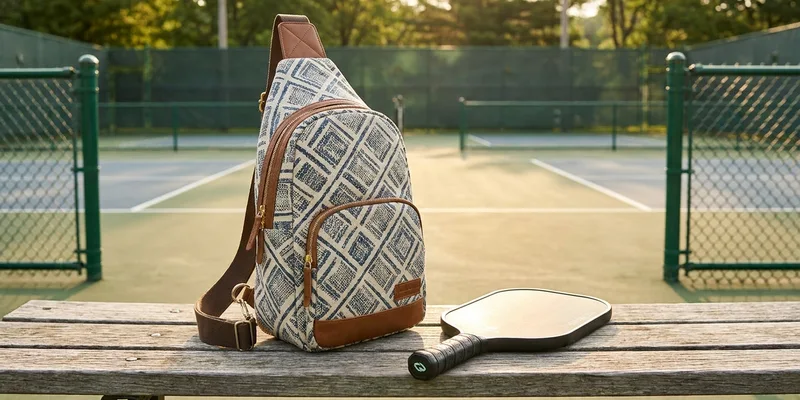
A sling is a single-strap bag worn diagonally across the back or chest. It keeps both hands free, sits close to the body so it does not swing while you walk, and is usually built around a padded paddle sleeve with one or two zipped pockets for balls, keys, and a phone.
A tote is an open-top or lightly closed carry bag with two handles, often with an external paddle pocket on the side. It holds a similar amount but organizes it differently: everything is reachable from the top without unzipping anything, which is why it works well as a bag that sits beside you between games.
Why They Get Compared
Both are the same answer to the same question, which is how to carry a paddle, balls, a towel, and a bottle without hauling a full backpack. The split is purely about how you want the weight handled: on your body while moving, or in your hand and then on the ground.
Sling vs Tote at a Glance
The table compares the two on the factors that actually change day to day: how the weight is carried, how quickly you can reach your gear, how well the contents are protected, and the kind of session each shape suits best. Capacity is close enough between them that it rarely decides the purchase.
| Factor | Sling bag | Tote bag |
|---|---|---|
| How it carries | Across the body, hands free | By hand or over one shoulder |
| Access | Swing it around to open a zip | Reach straight in from the top |
| Weather | Closed construction protects contents better | Open tops let rain and dust in |
| Best for | Walking to courts, cycling, transit | Courtside sessions, driving straight up to the court |
Which One Suits You
Pick by the ten minutes before and after you play rather than by the bag itself. How far you walk, whether you sit courtside between games, and whether you carry anything else at the same time all decide this more reliably than capacity numbers do.
You Walk, Cycle, or Take Transit to the Court
A sling is the clear pick. Both hands stay free, the bag does not swing while you move, and the closed construction keeps your gear dry if the weather turns on the way. This is the single strongest case for a sling over anything else in the small-bag category.

You Drive Up and Play Courtside for a Couple of Hours
A tote makes more sense here. The bag spends most of its life on a bench rather than on your shoulder, and being able to reach a towel, a ball, or a phone without unzipping and reslinging a bag is a genuine daily convenience.

You Want a Smaller Frame Fit or Specific Styling
Strap length and body proportions vary more on slings than on backpacks, since the whole load rides one strap in a fixed diagonal. Bags cut for a smaller frame, in a wider range of colors, are a common reason players shop within a women’s line rather than a unisex listing.

You Carry a Premium Paddle and Want Better Protection
If the paddle is the expensive part of your kit, look for a sling with a genuinely padded and isolated paddle compartment rather than a divider in the main space. Brands aimed at competitive players tend to build that compartment more seriously than general sports brands do.

What to Check Before You Buy
Four things decide whether a small bag works: whether the paddle compartment is padded and separate, whether the strap adjusts far enough for your frame, whether there is a zipped pocket for keys and a phone, and whether the fabric handles a shower if you are ever outdoors with it.
Strap comfort is the one people underestimate on slings. A narrow, unpadded strap carrying a loaded bag on one shoulder gets uncomfortable quickly, and a wider strap with a shoulder pad is worth more than an extra pocket in daily use.
The Tote Trade-Off Nobody Mentions
Open-top totes are convenient right up until the bag tips over or it starts raining. If you play outdoors regularly, look for a tote with at least a partial zip or a covering flap, and treat a completely open top as a fair-weather and indoor choice.
When Neither Is the Right Bag
Both shapes stop working the moment court shoes enter the equation. Neither a sling nor a tote is built with a ventilated shoe compartment, and damp outdoor shoes sharing space with a paddle sleeve and a clean shirt is exactly the problem a backpack solves.
The same applies once you carry three or more paddles or bring gear for a partner. At that point the seams on a small bag are taking strain they were not designed for. Our pickleball bag guide covers the backpack and duffel options that handle it properly.
Mistakes Worth Avoiding
The most common one is overloading a sling. A bag rated for one or two paddles will physically hold three, but the padded sleeve is no longer sized to protect each one and the single strap carries a load it was not built for. Size up rather than forcing it.
The second is buying a tote for a court you have to walk to. Carrying a loaded tote by hand for even a few hundred meters is noticeably worse than wearing the same weight across your back, and it is the kind of thing you only discover after the purchase.
Frequently Asked Questions
Is a sling bag big enough for pickleball? For one or two paddles, balls, a towel, a phone, and a bottle, yes. It stops being enough once you add court shoes or a change of clothes.
What is the difference between a pickleball sling bag and a tote? A sling is worn across the body on one strap and keeps your hands free. A tote is carried by hand or on the shoulder and gives faster top access to everything inside.
Can a sling bag hold two paddles? Many are built for exactly that. Check the stated paddle capacity on the specific listing rather than assuming, since sleeve sizing varies between models.
Do sling bags have a shoe compartment? Almost never. If you change shoes at the court, a backpack with a ventilated shoe pocket is the right category rather than a sling.
Is a tote bag good for outdoor pickleball? Only with a partial zip or a covering flap. A fully open tote leaves gear exposed to rain and dust and tips its contents out easily.
Which is better for women, a sling or a tote? It depends on the walk to the court rather than on the player. What is worth checking either way is strap length and bag proportions, which is why many players shop a bag for women line specifically.
The Bottom Line
Slings and totes carry a similar amount and differ almost entirely in how that weight sits and how fast you can reach it. Choose a sling if you walk, cycle, or take transit to the court and want your hands free, and a tote if you drive up and want everything reachable from a bench. Whichever way you go, insist on a padded paddle compartment separate from the main space, and step up to a backpack the moment court shoes join the kit. Our packing checklist covers what should actually be in there.