Last updated: August 19, 2026
Pick up a pickleball for the first time and the instinct is immediate: this is a wiffle ball. Hollow plastic, holes drilled through it, light in the hand, obviously descended from something you threw around a backyard as a kid. The instinct is half right, which is exactly why the comparison keeps coming up.
The two balls come from the same idea and were designed for opposite purposes. One was engineered to curve wildly so a kid could pitch it in a small yard. The other is engineered to fly straight and predictably so a rally can last. This guide covers where each came from, what the holes actually do, and why swapping one for the other does not work.
Quick Answer
Is a pickleball just a wiffle ball?
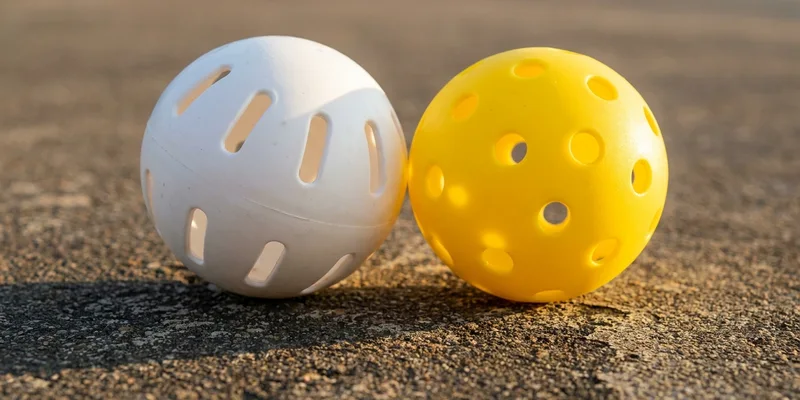
- No. A classic Wiffle Ball has slots cut into one half of the ball only, which makes it curve sharply on purpose. A pickleball has holes distributed evenly all the way around, so it flies straight.
- A pickleball is harder, heavier and built to bounce off a court surface. A Wiffle Ball is lighter and built to be pitched and hit with a plastic bat.
- Pickleballs are made to a published specification covering size, weight, hardness and bounce. Wiffle Ball is a trademarked toy brand, not a regulated piece of sports equipment.
Bottom line: they share an ancestor in cheap perforated plastic, but the hole pattern is the whole difference, and it is a designed one.
Wiffle Ball vs Pickleball at a Glance
Both are hollow perforated plastic spheres and both were invented in backyards. Everything after that diverges: the hole pattern, the intended flight, the weight, the game around them, and whether any specification governs how they are made.
| Category | Wiffle Ball | Pickleball |
|---|---|---|
| Hole pattern | Oblong slots in one hemisphere, the other half solid | Round holes distributed evenly around the whole ball |
| Intended flight | Curves sharply, by design | Straight and predictable |
| Build | Light, thin plastic, made to be pitched | Harder, heavier, made to bounce off a court |
| Struck with | A slim plastic bat | A solid composite paddle |
| Standards | A trademarked product, not a regulated spec | Specification published in the USA Pickleball rulebook |
| Origin | Connecticut, 1953 | Bainbridge Island, Washington, 1965 |
Where the Wiffle Ball Came From
The Wiffle Ball was invented in 1953 in Fairfield, Connecticut, by David N. Mullany, who was trying to give his son a ball that could be made to curve without wrecking a young arm. He experimented with cutting openings into hollow plastic spheres until one design broke sharply and reliably, and that design became the product.
The name is generally traced to whiff, the slang for a swing that misses, because the prototype produced a great many of them. WIFFLE remains a registered trademark rather than a generic term, which is why the capital letters matter to the company and why a lot of similar balls are sold under other names.
Why the Slots Are Only on One Side
The asymmetry is the entire trick. With openings on one hemisphere and a smooth surface on the other, air moves differently over each side of the ball in flight, and the ball breaks toward the smooth side. A pitcher can aim the slots and get a curve that a solid ball would need real technique and arm speed to produce.
What a Pickleball Is Built to Do
A pickleball is designed for the opposite outcome. Its holes are spread evenly around the sphere so that air behaves the same way whichever way the ball is oriented, which means the flight is predictable and a rally can be built on it. Unpredictable movement is a defect here, not a feature.
The ball is also harder and heavier than a Wiffle Ball, because it has to survive being struck by a composite paddle and bounce consistently off a hard court. That extra mass is what allows a pickleball to hold a line through a light breeze and to come off the surface at a usable height.
Indoor and Outdoor Balls Are Not the Same Either
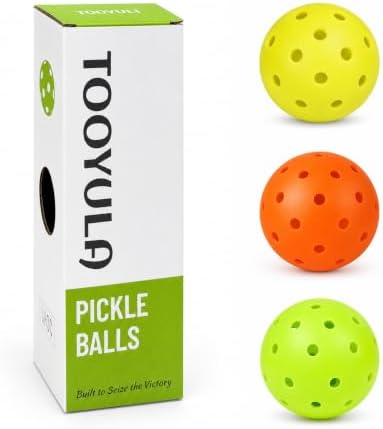
Outdoor pickleballs commonly use a larger number of smaller holes in harder plastic, so they resist wind and carry pace. Indoor balls commonly use fewer, larger holes in a softer plastic, which makes them slower and easier on gym floors. Our comparison of indoor and outdoor balls covers what changes on court.
Pickleballs Are Made to a Published Specification
USA Pickleball sets requirements for the balls used in sanctioned play, covering diameter, weight, hardness, bounce and how round the ball has to be, and publishes them in its rulebook at usapickleball.org. Balls that meet them and are submitted for approval appear on an official list.
Nothing equivalent governs a Wiffle Ball, which is a consumer product from a single company rather than regulated sports equipment. That difference is the clearest sign that the two objects live in different worlds despite looking related on a shelf.
The Backyard Origin Both Sports Share
Pickleball was invented in 1965 on Bainbridge Island, Washington, by three fathers improvising a game on a badminton court with household equipment. Accounts of that first afternoon describe a perforated plastic ball, and retellings often reach for the word wiffle because that is the ball most readers picture.
Whether the original was a Wiffle Ball specifically or another perforated plastic ball is not settled in the sport’s own histories, and it matters less than what happened next: the ball was standardised into purpose-built equipment. Our account of when pickleball was invented covers the timeline, and our piece on why it is called pickleball sorts out the naming stories.
Two Inventions, Twelve Years Apart
The Wiffle Ball came first, in 1953, and by 1965 perforated plastic balls were an ordinary household item across America. That availability is part of why pickleball started with one. A sport improvised in a backyard uses whatever the backyard contains.
Can You Play Pickleball With a Wiffle Ball?
You can hit one, but you cannot play a proper game. A Wiffle Ball is too light to hold its line off a paddle, its asymmetric slots make the flight curve unpredictably, and it does not bounce off a court in a way the two-bounce rule can work with. Rallies collapse within a few shots.
For sanctioned play the question does not arise, since events specify an approved ball. Even in a driveway game, a cheap set of proper outdoor balls transforms the experience far more than most beginners expect. Our overview of which pickleball fits which court covers the options.
Why the Two Games Feel Nothing Alike
Wiffle ball is a backyard version of baseball: a pitcher, a batter, a plastic bat, and often no fielders at all. The curving ball is the point of the game, and the fun comes from breaking pitches that would be impossible with a hardball in a small space.
Pickleball is a court sport with a net, a non-volley zone and a rulebook, where consistency is what wins points. One game is built around making the ball behave unpredictably, the other around making it behave the same way every time, and that single opposition explains why the equipment diverged.
Frequently Asked Questions
Is a pickleball a wiffle ball? No. A pickleball has round holes spread evenly around the whole ball so it flies straight, while a classic Wiffle Ball has slots in one hemisphere only, which makes it curve on purpose. A pickleball is also harder and heavier.
Why does a wiffle ball curve so much? Because the openings are only on one side. Air behaves differently over the perforated half than over the smooth half, so the ball breaks in flight, which is exactly what the design was created to do.
Was pickleball invented with a wiffle ball? Accounts of the first game in 1965 describe a perforated plastic ball, and retellings often call it a wiffle ball. The sport’s histories are not consistent on the exact ball, and purpose-made pickleballs followed soon after.
Which came first, the wiffle ball or pickleball? The Wiffle Ball, by twelve years. It was invented in 1953 in Fairfield, Connecticut, while pickleball was invented in 1965 on Bainbridge Island, Washington.
Can you use a wiffle ball for pickleball practice? It is a poor substitute. The flight, weight and bounce are all wrong, so you would be grooving a response to a ball that behaves nothing like the one you play with. Practice balls sold for pickleball are a better answer.
How many holes does a pickleball have? It varies by ball and by whether it is built for indoor or outdoor play. Outdoor balls commonly have a larger number of smaller holes and indoor balls fewer, larger ones. The specification that matters is published in the USA Pickleball rulebook at usapickleball.org.
Is Wiffle a brand name? Yes. WIFFLE is a registered trademark of the company that has made the ball since the 1950s, which is why similar perforated plastic balls from other manufacturers are sold under different names.
The Bottom Line
A pickleball and a Wiffle Ball are cousins, not twins. Both are hollow perforated plastic and both come from backyard invention, but the Wiffle Ball’s one-sided slots were designed to make the ball curve, while a pickleball’s evenly spread holes exist to stop it curving. Add a harder, heavier build and a published specification and you have two objects with opposite jobs. If you are buying, our guide to which pickleball fits which court is the practical next step, and our history of the sport covers the rest of the backyard story.