Last updated: August 18, 2026
Most players give the ball about four seconds of thought and then buy whatever the store has. It works out fine right up until the group is arguing about why the game feels slow this week, or half a pack has cracked before the month is out, or someone brings gym balls to an outdoor court on a windy afternoon.
Balls are the one thing in pickleball you buy over and over, which makes getting the choice right once genuinely worth ten minutes. This guide sorts every mainstream option by the court you play on and the situation you play in, and points to the detailed guide for each one.
Quick Answer
Which pickleball balls should you buy?
- Outdoors on asphalt or concrete: an outdoor ball with 40 small holes. The Franklin X-40 is the safe default, the Dura Fast 40 is the fast one.
- Indoors on a gym floor: an indoor ball with fewer, larger holes and a softer shell.
- Recreational groups tired of cracked balls: a more forgiving outdoor ball such as the Onix outdoor line.
- Driveways and noise sensitive settings: foam or another quiet option, accepting that the game plays slower.
Pick the surface first, then pick pace versus lifespan. That is the whole decision.
The Only Two Questions That Matter
Every ball decision reduces to two questions. Where do you play, indoors or outdoors, and would you rather have more pace or more sessions per ball. Answer those and the shortlist is usually down to two products before you have looked at a single listing.
Surface comes first because it is not a preference, it is a constraint. Outdoor balls are harder with 40 small holes so wind moves them less, indoor balls are softer with fewer larger holes because there is no wind to fight. Our indoor versus outdoor comparison covers exactly what differs and how to tell them apart without packaging.
Pace and Durability Pull in Opposite Directions
Harder shells return more energy and crack sooner. Softer shells absorb more and last longer. There is no ball that beats the rest on both counts, so the honest question is which end of that line suits how your group actually plays.
Pickleball Balls Compared by Situation
Outdoor Club and Recreational Play
The Franklin X-40 is the ball most American outdoor groups already use, which makes it the least disruptive choice for shared play. Balanced pace, wide availability, and a familiar flight are the reasons it stays in the bin. Full detail in our Franklin X-40 guide.

Competitive Outdoor Play and Fast Hands Drilling
The Dura Fast 40 is the hard, quick ball a large part of the tournament scene grew up on. It rewards players who want pace and punishes anyone hoping the pack will last, especially in cold weather. Our Dura Fast 40 guide goes through that trade in full.

Groups Replacing Balls Too Often
If cracked balls are the recurring complaint, a more forgiving outdoor ball is the fix. The Onix outdoor line is the common choice, giving up a fraction of pace for a longer working life, which suits weekly recreational sessions well. See our Onix ball guide.

Gym Floors and Community Centers
Indoor balls are softer, quieter, and easier to control on a smooth floor, and they fail by going out of round rather than by cracking. Bringing an outdoor ball into a gym is loud and unnecessary. Our indoor pickleball balls guide covers the field.
Driveways, Neighbors, and Noise Restrictions
Where the sound is the problem, foam and other quiet options are the realistic answer, with the honest caveat that they play slower and lighter than a standard ball. Our guide to quiet pickleball balls explains how much you give up.

Clubs, Schools, and Ball Machine Drilling
Anyone supplying a group or feeding a pickleball ball machine is buying by the dozen. Bulk packs of a single model cost less per ball and, more importantly, keep every ball in the bin behaving the same way.

The Comparison Table
Here is the whole field on one screen. Read across the row that matches where you play, then choose between pace and lifespan within it.
| Ball type | Holes and shell | How it plays | How it fails |
|---|---|---|---|
| Outdoor tournament ball | 40 small holes, hardest shell | Fastest, sharpest sound | Cracks soonest, worse in cold |
| Outdoor balanced ball | 40 small holes, hard shell | Familiar pace, true flight in wind | Cracks eventually |
| Outdoor recreational ball | 40 small holes, more forgiving | Slightly slower and duller | Longest life of the outdoor group |
| Indoor ball | Fewer, larger holes, soft shell | Controllable, quieter, more dwell | Goes soft or out of round |
| Foam or quiet ball | Foam or low noise plastic | Slow, light, drifts in any breeze | Wears and compresses |
What Ball Colour and Brand Do Not Tell You
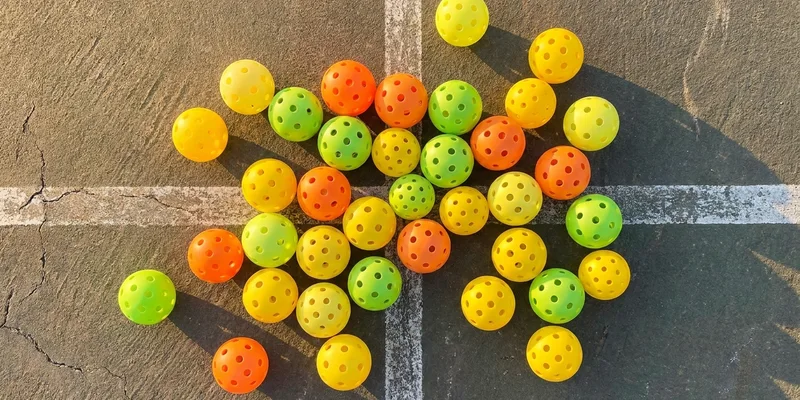
Colour is about visibility against a specific court and background, not construction. Both indoor and outdoor balls are sold in yellow, neon green, orange, and white, so a colour tells you nothing useful about where a ball belongs.
Brand is almost as weak a signal, because most established brands sell both indoor and outdoor lines. The reliable checks are the words indoor or outdoor in the product title, the hole count when the balls arrive, and how the ball feels under thumb pressure. Count 40 small holes and you have an outdoor ball.
Approval, Tournaments, and When It Matters
USA Pickleball maintains the list of balls approved for sanctioned play, built on published specifications for size, weight, bounce, and hole pattern. Approval is a compliance mark rather than a quality ranking, and unapproved balls are perfectly good for recreational sessions.
If you are entering sanctioned events, check the current list on usapickleball.org, because models come on and off it and packaging is often out of date. Also check separately which ball your specific tournament has chosen, since any approved ball is a legitimate option for an organizer. Our explainer on what approval actually means covers the wider principle.
Mistakes That Cost Groups the Most
Mixing models within a session is the quiet killer. Different balls carry genuinely different pace, so rotating between two brands mid game degrades everyone’s timing without anyone identifying the cause. Choose one model per group and buy enough of it.
The second is buying sleeves instead of packs. Outdoor balls are a consumable with an abrupt end of life, so running out mid session is a matter of when rather than if. Keeping spares in your pickleball bag and buying by the dozen solves both problems at once.
Frequently Asked Questions
What is the best pickleball ball overall? There is no single answer, because outdoor and indoor balls are different products. Outdoors, the Franklin X-40 is the widely used default. Indoors, a proper indoor ball beats any outdoor ball.
How do I tell an indoor ball from an outdoor ball? Count the holes. Indoor balls commonly have fewer and larger holes, outdoor balls commonly have 40 smaller ones, and an indoor ball also gives more under thumb pressure.
How often do pickleball balls need replacing? There is no fixed schedule. It depends on temperature, surface roughness, and how hard your group hits. Outdoor balls typically end by cracking, indoor balls by going out of round.
Do more expensive balls play better? Not necessarily. The meaningful differences are shell hardness, construction, and whether the ball matches your surface, and the most suitable ball for a recreational group is often not the tournament one.
Can I use one ball type for both indoor and outdoor play? You can compromise, but neither direction works well. Outdoor balls are loud and fast in a gym, and indoor balls drift outdoors in the mildest wind.
Are quiet balls a real solution for noise complaints? They help. On their own they rarely settle the issue, since the paddle, the court position, and playing hours all contribute at least as much as the ball does.
The Bottom Line
Pick the surface first and the rest follows. Outdoors, decide between a fast tournament ball and a longer lasting recreational one, and expect cracking either way. Indoors, use a proper indoor ball rather than an outdoor one in a gym. In noise sensitive settings, accept that a quieter ball plays slower. Then buy one model in quantity and keep the whole group on it. The detailed guides are outdoor balls, indoor balls, and quiet balls.