Last updated: August 18, 2026
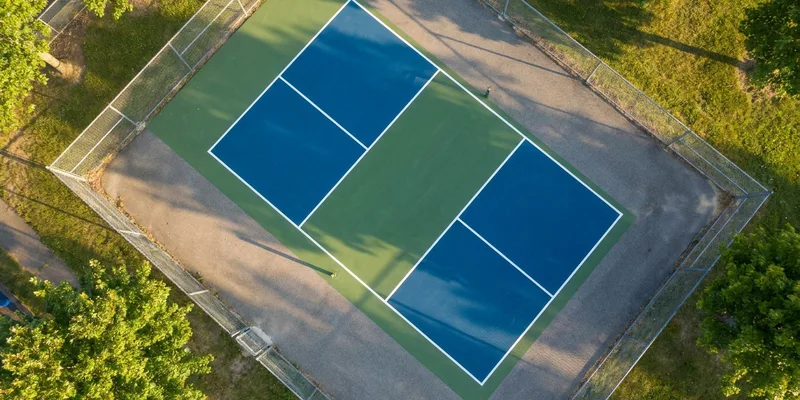
Every pickleball court shares the same measurements, whether it is a converted tennis court, a backyard build, or a dedicated facility with a dozen courts side by side. Knowing the pickleball court dimensions matters for more than trivia: it determines how much space you need to build one, how far you can expect to run during a rally, and where the lines that shape the entire game, especially the kitchen, actually sit.
This guide covers the full pickleball court size in both feet and meters, breaks down every zone on the court, and explains how much total space you need once you account for the area around the lines. All figures below are checked against the official USA Pickleball rulebook, which the organization updates at the start of each year, so treat these as the current standard rather than a number carved in stone forever.
Quick Answer
What are the official pickleball court dimensions?
- A regulation pickleball court measures 20 feet wide by 44 feet long (6.10 by 13.41 meters), the same size for singles and doubles.
- The non-volley zone, or kitchen, extends 7 feet (2.13 meters) from the net on each side, across the full width of the court.
- The playing lines alone are not enough space to build on: USA Pickleball and court-building guides recommend at least 30 by 60 feet of total area, with 34 by 64 feet as a more comfortable standard.
Pickleball Court Dimensions in Feet and Meters
The table below lists every measurement that defines a regulation court, from the outer boundary lines down to the net. Use it as a quick reference, then read on for what each zone means during play.
| Measurement | Feet | Meters |
|---|---|---|
| Total court length | 44 ft | 13.41 m |
| Total court width | 20 ft | 6.10 m |
| Non-volley zone (kitchen), from net | 7 ft per side | 2.13 m per side |
| Combined kitchen depth (both sides) | 14 ft | 4.27 m |
| Baseline to kitchen line | 15 ft per side | 4.57 m per side |
| Net length (post to post) | 22 ft | 6.71 m |
| Recommended minimum total space | 30 x 60 ft | 9.14 x 18.29 m |
Court Size: The 20 by 44 Foot Rectangle
A pickleball court size is 20 feet wide and 44 feet long, converting to roughly 6.10 by 13.41 meters. That figure never changes based on whether you are playing singles or doubles; unlike tennis, where singles and doubles use different width lines, pickleball uses the exact same boundary for both formats. If a fact sheet or product listing quotes a different width for singles play, it is describing a different sport, not a pickleball variant.
For scale, that footprint is the same size as a doubles badminton court, which is a useful mental shortcut if you have ever seen one in person. It is considerably smaller than a tennis court, which explains why converted tennis courts can typically fit two to four pickleball courts inside the same fenced area, a detail covered in more depth in our pickleball court vs tennis court comparison.
The Non-Volley Zone: 7 Feet That Shapes the Whole Game
The non-volley zone, universally known as the kitchen, extends 7 feet from the net on each side, spanning the full 20-foot width of the court. Combined, the two kitchens account for 14 feet of the court’s 44-foot length, right down the middle, with the net splitting that strip exactly in half.
What is left over is the area between each kitchen line and the baseline: 22 feet from net to baseline on each side, minus the 7-foot kitchen, leaves 15 feet of standard playing surface behind each kitchen line. That 15-foot strip is where most serves land and where baseline rallies happen before players work their way forward. For the specific rules about what you can and cannot do inside that 7-foot strip, see our dedicated kitchen rules guide.
The Net: Width, Position, and Why It Matters for Dimensions
The net itself runs 22 feet from post to post, wider than the 20-foot court, so each side overhangs the sideline by about a foot. That overhang is intentional: it removes any ambiguity about whether a shot near the edge of the court cleared the net cleanly. The net’s height changes across that width too, higher at the posts than in the middle, which is enough of its own topic that it gets a full breakdown in our pickleball net height guide.
Court builders sometimes ask whether the net posts sit on the sidelines or outside them. Per the regulation layout, the posts sit outside the sidelines, which keeps the entire painted playing surface clear of hardware players could clip while chasing a wide shot.
How Much Total Space You Actually Need
The 20 by 44 foot measurement only covers the painted lines. Anyone building a court, whether in a backyard or as part of a facility, needs meaningfully more room than that for safe play. Court-building guidance built around USA Pickleball’s standards generally puts the minimum usable space at 30 by 60 feet, a more comfortable recreational standard at 34 by 64 feet, and a tournament-ready standard at 40 by 70 feet, with the extra footage going toward run-off room behind the baselines and along the sides so players are not sprinting into a fence to chase a ball.
That extra space is not optional in any practical sense. Players routinely need to move several feet beyond the baseline or sideline to reach a shot, especially at the intermediate and advanced level, and a court built to the bare 20 by 44 foot minimum with no buffer creates a real collision and injury risk. If you are planning a home or club installation, our pickleball court construction cost guide breaks down what that additional space means for a build.
Court Dimensions in Feet: A Quick Cheat Sheet
For anyone who just needs the numbers without the explanation, here they are in feet, the unit most American court builders and players default to: the court is 20 by 44 feet, each kitchen is 7 feet deep, the two kitchens together take up 14 feet, and each baseline-to-kitchen strip is 15 feet. The net spans 22 feet across the posts. Keep this section bookmarked if you are marking out a court yourself and want the feet-only version without converting anything.
Marking Out a Court Yourself
If you are painting or taping lines on an existing slab, start with the outer 20 by 44 foot rectangle and use a carpenter’s square or the classic 3-4-5 triangle method at each corner to keep the lines truly perpendicular. A rectangle that is off by even a couple of inches at one corner becomes noticeably crooked by the time you reach the far end of a 44-foot line, so checking both diagonals for an equal length is the fastest way to confirm the layout is square before any paint goes down.
Once the outer boundary is marked, measure 7 feet in from the net line on both sides to mark the kitchen lines, and add a center line down each 15-foot backcourt to divide the left and right service boxes. That center line stops at the kitchen line and does not continue through the non-volley zone, since the kitchen is not divided into separate service boxes the way the backcourt is.
How Court Dimensions Compare Across Racket Sports
Pickleball’s 20 by 44 foot footprint sits at the small end of the racket-sport spectrum, which is exactly why so many facilities convert existing courts rather than building from scratch. A doubles badminton court uses nearly the same outer dimensions, which is part of why the two are so often confused on a facility map. A tennis court, by contrast, runs 78 feet long for singles and up to 36 feet wide for doubles, several times the area of a single pickleball court, which is the main reason multiple pickleball courts fit inside one retired tennis court with room to spare for the required buffer space around each one.
Frequently Asked Questions
Is a pickleball court the same size for singles and doubles? Yes. Unlike tennis, pickleball uses one court size, 20 by 44 feet, for both singles and doubles play, so no lines change between formats.
What is the pickleball court size in meters? A regulation court measures 6.10 by 13.41 meters. The 7-foot kitchen converts to 2.13 meters on each side of the net.
How many pickleball courts fit on one tennis court? Facilities commonly fit two to four pickleball courts within the footprint of one tennis court, depending on how much run-off space is included around each one.
Do the pickleball court dimensions in feet ever change between organizations? The core 20 by 44 foot playing surface is consistent across USA Pickleball and international federations. Recommended surrounding space can vary slightly between guidance documents, which is why this guide lists a range rather than a single fixed number.
How far is the baseline from the net? Each baseline sits 22 feet from the net, which splits into the 7-foot kitchen closest to the net and a 15-foot strip of standard court behind it.
Can I build a pickleball court smaller than the recommended minimum? You can paint lines in a smaller area, but going below roughly 30 by 60 feet of total space significantly increases the risk of players running into fences, walls, or each other during normal play.
The Bottom Line
A regulation pickleball court measures 20 by 44 feet, or 6.10 by 13.41 meters, with a 7-foot kitchen on each side of the net and the same dimensions used for singles and doubles alike. Add buffer space beyond the lines, at least 30 by 60 feet total, and you have everything you need to lay out or evaluate a court correctly. For how the game is actually played inside those lines, our how to play pickleball guide picks up from here.