Last updated: August 18, 2026
A pickleball court is a construction project, not a purchase, and that is why the quotes people get back vary so wildly. Two homeowners in different states can build what looks like the same court and pay figures that are thousands of dollars apart, because most of the money goes into the ground rather than into anything you can see once the lines are painted.
This guide breaks the total into its actual line items so you can see where a budget goes and which decisions move it most. Every figure below is an indicative range drawn from published contractor and industry cost guides for the United States. Prices vary considerably by region, site condition, and year, so treat these as planning brackets and get local quotes before committing to anything.
Quick Answer
How much does pickleball court construction cost?
- A single new outdoor court typically lands somewhere around $25,000 to $50,000, with published industry ranges stretching from roughly $15,000 at the low end to $75,000 or more for premium builds.
- Cost guides commonly express it as roughly $11 to $28 per square foot for a concrete pad topped with acrylic sport coating.
- Converting an existing tennis or sport court instead of building from scratch is dramatically cheaper, often in the range of $5,000 to $15,000.
All figures are indicative ranges from contractor and industry cost guides. Regional labor rates, soil conditions, and material prices move them significantly.
Pickleball Court Construction Cost at a Glance
The table below breaks a typical new-build budget into its main components, based on the 30 by 60 foot pad most projects use. That footprint is larger than the 20 by 44 foot playing surface because a court needs run-off space around the lines, a point covered in our court dimensions guide.
| Line item | Indicative range | What drives it |
|---|---|---|
| Site prep and drainage | $2,000 to $15,000 | Slope, soil type, tree removal, water management |
| Concrete base pad | $9,000 to $18,000 | Thickness, reinforcement, concrete prices in your area |
| Asphalt base, alternative | Roughly $7 to $15 per sq ft | Lower upfront, higher long-term maintenance |
| Acrylic surfacing and striping | $2,000 to $5,000 | Number of coats, color choice, line complexity |
| Fencing and lighting combined | $8,000 to $23,000 | Fence height and length, number of light poles |
| Net system | A few hundred up to a couple of thousand | Portable system versus permanent in-ground posts |
| Whole single court, typical | $25,000 to $50,000 | All of the above plus regional labor rates |
Site Preparation: The Line Item People Forget
Site work is the least visible part of the budget and the most likely to blow it. Clearing, grading, compacting the subgrade, and installing drainage commonly runs somewhere in the region of $2,000 to $15,000 before any concrete is poured, and the spread inside that range is almost entirely about your specific piece of ground.
A flat, well-drained lot with easy equipment access sits at the bottom of that range. A sloped yard, rocky or clay-heavy soil, a high water table, or a site that requires retaining work sits at the top or beyond it. Skipping proper drainage is the single most expensive mistake available here, because water sitting under or on a court is what causes the cracking and surface failure that leads to a rebuild years earlier than planned.
The Base: Concrete, Asphalt, or Post-Tensioned
The base is the biggest single material cost and the decision with the longest consequences. Concrete is the most commonly recommended base for a permanent court and typically runs around $9,000 to $18,000 for a 30 by 60 foot pad. It holds its shape well and gives the surfacing layer a stable substrate.
Where Asphalt and Post-Tensioned Concrete Fit
Asphalt, roughly $7 to $15 per square foot in published guides, costs less upfront but is more prone to cracking and needs more frequent attention over its life, so the saving is partly borrowed from your future maintenance budget. Post-tensioned concrete sits at the premium end, commonly quoted around $15 to $20 per square foot, using internal steel cables to resist cracking and stretch out the interval between resurfacing cycles. In regions with expansive soils or hard freeze and thaw cycles, contractors often argue that premium is worth paying rather than an upgrade.
Surfacing and Line Striping
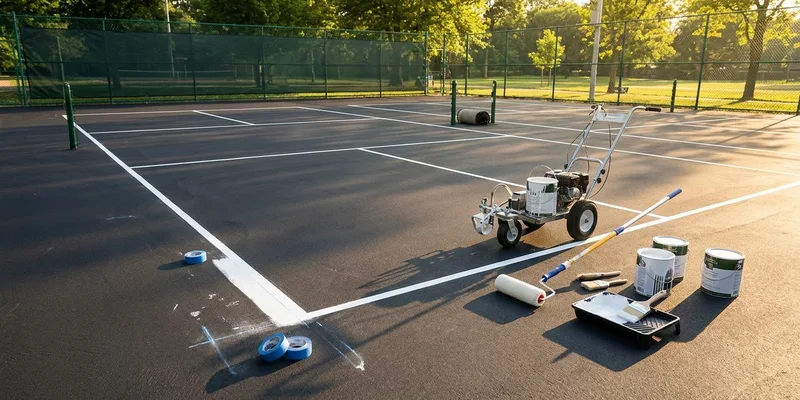
The colored layer you actually play on is a relatively small share of the total, generally around $2,000 to $5,000 for a standard court. A typical specification includes two coats of acrylic resurfacer to smooth the base, two coats of colored sport surfacing, and line striping in a contrasting color.
This is also where you decide whether the court is pickleball only or shares lines with another sport. Adding a second set of lines costs relatively little at the striping stage and a great deal later if you change your mind, since it means re-coating the surface rather than adding paint.
Fencing, Lighting, and the Net System
Fencing and lighting together commonly add somewhere around $8,000 to $23,000, which is enough to be a genuine fork in the road rather than a detail. Fencing scales with height and perimeter length, so a full-height enclosure on all four sides costs far more than back fencing behind the baselines only, which is a common compromise on residential builds.
Lighting is the item most often deferred. Poles, fixtures, trenching, and electrical work make it expensive, and it is one of the few components that can genuinely be added in a later phase without tearing anything up, provided you have the conduit run during construction. The net itself is minor by comparison, ranging from a few hundred dollars for a quality portable system to a couple of thousand for permanent in-ground posts. Our pickleball net guide covers what separates the two.
What Pushes a Quote Up or Down
Beyond the line items, four factors explain most of the variation between quotes. Region is the largest: labor rates and material costs in the Northeast and on the Pacific Coast typically run well above the Midwest and South for an identical build. Access matters next, because a backyard a truck cannot reach means smaller equipment, more hours, and sometimes hand-pouring.
Scale works in your favor. Building two or more courts side by side lowers the per-court cost meaningfully, since mobilization, site prep, and equipment transport are shared across the project. Finally, timing plays a role: contractors in warm-climate markets book out heavily in spring, and quotes obtained in the off-season are sometimes more competitive.
Cheaper Routes to a Playable Court
If the new-build range is out of reach, three cheaper paths exist. Converting an existing tennis court, sport court, or unused slab is by far the biggest saving, commonly quoted around $5,000 to $15,000 depending on the condition of the surface underneath. Restriping alone, on a surface already in good shape, is often around $800 to $2,000.
Modular snap-together tile over an existing slab is a middle option that avoids wet trades entirely, and a plain striped driveway or slab with a portable net is the cheapest playable setup of all. None of these give you a tournament-grade surface, but for recreational play in a backyard the difference matters less than most sales pages imply.
Costs That Continue After the Build
A court is not a one-time expense. Resurfacing is the main recurring item, commonly cited around $1,500 to $3,500 for a standard court, covering crack repair, a fresh resurfacer coat, two color coats, and new lines. Most guidance puts that on a multi-year cycle, with the interval depending on climate, base type, and how heavily the court is used.
Beyond resurfacing, expect ongoing minor costs for crack sealing, net replacement, cleaning, and eventually lighting maintenance. Property tax implications and homeowner insurance adjustments are worth checking with your local authority as well, since a permanent court is a structural improvement in many jurisdictions.
Frequently Asked Questions
How much does it cost to build one pickleball court? Published contractor and industry guides typically put a single new outdoor court around $25,000 to $50,000, with the full spread running from roughly $15,000 for a basic build to $75,000 or more with premium surfacing, full fencing, and lighting. All figures are indicative and vary by region and year.
Is asphalt or concrete cheaper for a pickleball court? Asphalt is usually cheaper upfront but needs more maintenance and is more prone to cracking. Concrete costs more initially and generally holds up better over the life of the court.
How much does it cost to convert a tennis court to pickleball? Conversions commonly run around $5,000 to $15,000 depending on the surface condition, and simple restriping on a court already in good shape can be closer to $800 to $2,000.
Does adding lights significantly increase the cost? Yes. Fencing and lighting together are commonly quoted around $8,000 to $23,000, and lighting is the more electrically involved of the two. Running conduit during construction keeps the option open for a later phase.
Do I need a permit to build a pickleball court? Usually yes for a permanent build, and requirements vary by municipality and homeowners association. Check locally before budgeting, since permit conditions can affect fencing, lighting, and setback requirements.
How often does a pickleball court need resurfacing? On a multi-year cycle that depends on climate, base material, and usage. Cost guides commonly place a resurfacing job around $1,500 to $3,500 for a standard court.
The Bottom Line
Pickleball court construction cost is mostly a ground-works question. Site prep and the base pad account for the bulk of a typical $25,000 to $50,000 build, while surfacing, netting, and striping are comparatively small. Fencing and lighting are the two optional items with the power to move the total by five figures, and converting an existing court sidesteps most of the expense entirely. For how the build itself unfolds and what your quote should actually itemize, see our pickleball court installation cost guide.