Last updated: August 19, 2026
A lot of pickleball courts are full of former racquetball players, and most of them tell the same story: the reflexes came across immediately, and the swing took months to fix. That is the honest summary of what happens when you move from a sport played inside a box to one played across a net.
This guide compares the two sports on court, equipment, rules and pace, then spends most of its time on the part that actually matters if you are switching: which of your habits are assets and which ones will quietly cost you points for the first few weeks.
Quick Answer
What is the difference between racquetball and pickleball?
- Racquetball is played inside an enclosed court where the walls, ceiling and floor are all in play, with a strung racket and a fast rubber ball. There is no net between the players.
- Pickleball is played across a net on an open 44 by 20 foot court, with a solid paddle and a perforated plastic ball, and it adds a non-volley zone at the net.
- Racquetball players usually adapt fast, because the hand-eye timing transfers. The problem is the wrist-heavy swing and the instinct to attack every ball.
Bottom line: same reflexes, opposite geometry. In racquetball a wall gives you a second chance, in pickleball a missed ball is simply gone.
Racquetball vs Pickleball at a Glance
The two sports share a family resemblance in pace and in the demands they place on your hands, and almost nothing else. One is a confined, enclosed game where the boundary is part of the play, the other is an open court game where the boundary ends the point.
| Category | Racquetball | Pickleball |
|---|---|---|
| Playing area | Enclosed court, walls and ceiling in play | Open court, 44 ft by 20 ft, divided by a net |
| Net | None | Yes, lower than a tennis net |
| Implement | Short strung racket with a wrist tether | Solid paddle, no strings, no tether |
| Ball | Hollow rubber, fast and high bouncing | Hard perforated plastic, slower and low bouncing |
| Serve | Struck after a bounce, into the front wall | Underhand and diagonal, below the waist |
| Signature rule | The ball stays live off the walls | Non-volley zone and the two-bounce rule |
The Courts Work in Opposite Directions
A racquetball court is a sealed room. Front wall, side walls, back wall, ceiling and floor are all part of the playing surface, and both players occupy the same space rather than facing each other from separate halves. A ball that gets past you can still come back off the back wall.
A pickleball court is an open rectangle divided by a net, with each side responsible for its own half and the lines ending the point rather than continuing it. Our guide to pickleball court dimensions covers the layout, including the 7 foot non-volley zone that runs across each side of the net.
What Losing the Walls Actually Changes
In racquetball, positioning is largely about controlling the centre of the box and reading rebounds. In pickleball, positioning is about getting to the kitchen line and holding it. The skill of anticipating where a ball will end up transfers directly. The specific geometry you learned it in does not.
Equipment: Racket Against Paddle
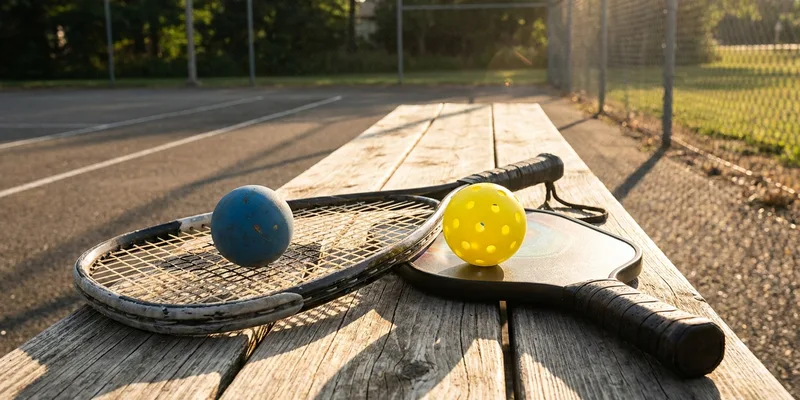
A racquetball racket is strung, short, light and worn on a tether around the wrist, and it is built to generate racket head speed in a confined space. A pickleball paddle is a solid composite face over a honeycomb core, with no strings and no tether, tuned for touch and spin rather than for pure speed.
The balls diverge just as sharply. Racquetball uses a fast, high bouncing hollow rubber ball built for the walls. Pickleball uses a hard plastic ball with holes drilled through it, which flies slower, bounces low and is noticeably affected by wind outdoors. Neither implement makes sense with the other ball.
Eyewear Habits Are Worth Keeping
Protective eyewear is standard practice in racquetball and required in sanctioned play, and that habit is worth carrying across. Pickleball does not mandate eyewear, but the ball travels fast in doubles at the kitchen line and eye injuries do happen. Our piece on eye protection in pickleball covers what players actually wear.
Rules a Racquetball Player Has to Learn
Three rules cause almost every early mistake. The serve must be underhand and struck below the waist, diagonally into the opposite service court. The two-bounce rule means the serve and the return must each bounce before anyone volleys. And the non-volley zone forbids hitting the ball out of the air while standing in it.
The kitchen rule is the one that takes longest to absorb, because it forbids exactly what a wall sport player wants to do: step in and crush a high ball at the net. Our guide to how the kitchen actually works covers the edge cases, including momentum carrying you into the zone after a volley.
Scoring Feels Familiar
Traditional pickleball scoring will not surprise you: only the serving side scores, and games run to 11 and must be won by two. Racquetball’s own convention of the server scoring is the same idea with different numbers. Rally scoring formats exist in both worlds, so check which one your local group uses.
What Transfers From Racquetball
Reaction speed is the big one. Racquetball trains you to track a fast ball in a small space and get an implement on it, and that is precisely the skill that decides hands battles at the kitchen line. Court awareness, footwork in tight spaces and comfort with a fast exchange all come across intact.
Competitive habits transfer too. Wall sport players tend to be comfortable playing close to an opponent, tend to move well laterally, and rarely get flustered by pace. In doubles at a recreational level, that combination alone puts a former racquetball player ahead of most beginners within a few sessions.
What Works Against You
The wrist is the main culprit. Racquetball rewards a whippy, wrist-driven stroke that generates speed in a short space, and that same motion in pickleball produces balls that fly long or pop up invitingly. Pickleball strokes are shorter, more shoulder-led and much more controlled, especially on the soft shots.
The second habit is aggression. In racquetball, hitting hard is usually the right answer because a wall keeps the ball alive. In pickleball, hitting hard from the wrong part of the court hands your opponents an easy put-away. Learning the third shot drop and the reset is what converts a fast former racquetball player into an actually good pickleball player.
Expect Your First Paddle to Be Wrong
Racquetball converts often reach straight for the most powerful paddle in the shop, because power is what their old sport rewarded. A more forgiving paddle with a thicker core usually serves them better for the first season, while the soft game is still being built. Our guide to choosing a first paddle covers what actually matters.

Availability and Physical Demand
Court access decides this for a lot of people. Racquetball courts are tied to gyms and clubs and have become harder to find in many American towns, while pickleball courts, converted tennis courts and portable nets have spread rapidly. The sport you can actually book beats the sport you would slightly prefer.
Both sports are genuine exercise and both load the body in demanding ways: racquetball with explosive movement and sudden direction changes in a confined space, pickleball with repeated lateral steps and long time on your feet. Neither is automatically gentler than the other, and anyone with a joint issue, an existing injury or a long layoff should get guidance from a doctor or physical therapist rather than assume.
Footwear Is Not Interchangeable Either
Indoor court shoes built for racquetball will work on an indoor pickleball court, but outdoor pickleball on asphalt or concrete chews through soft indoor outsoles quickly. Our overview of pickleball shoes covers what changes between the two surfaces.
Frequently Asked Questions
Is racquetball harder than pickleball? Racquetball is generally harder to start, because the ball is faster and reading rebounds off multiple walls takes time. Pickleball is easier to begin and has a long ceiling of its own once the soft game becomes the deciding factor.
Do racquetball skills transfer to pickleball? Yes, especially reaction speed, hand-eye coordination and comfort in fast exchanges. The transfer breaks down on technique, since racquetball’s wrist-driven stroke produces balls that sail long or pop up in pickleball.
Can you play pickleball with a racquetball racket? No. Pickleball requires a solid paddle, and a strung racket is not legal equipment for the sport, quite apart from being wrong for the ball.
Which sport is a better workout? They demand different things: racquetball involves explosive movement in a confined space, pickleball involves repeated lateral movement and sustained time on your feet. Neither is automatically lighter, and how hard you work depends far more on how you play than on which sport you pick.
Why are racquetball courts being converted to pickleball? Demand has shifted, and a single racquetball court can host recreational pickleball with a portable net where a facility sees more players per hour. Court conversions follow participation rather than any judgement about the sports.
Is the pickleball serve like a racquetball serve? No. A pickleball serve is struck underhand and below the waist, diagonally into the opposite service court, and it is a much more restricted shot than a racquetball serve. Our rules guide covers the current serve requirements.
Should I wear eye protection for pickleball? It is not required, but plenty of players who come from wall sports keep the habit. The ball moves quickly during net exchanges in doubles, and eyewear costs little compared to the risk it covers.
The Bottom Line
Racquetball and pickleball share reflexes and share nothing else structurally. One is played inside a box where the walls keep the ball alive, the other across a net on an open court where a missed ball ends the point. Former racquetball players start fast because their hands are already trained, then plateau until they trade the wrist-driven swing for a controlled one and learn to reset instead of attack. If you are weighing pickleball against another racket sport, our comparison of pickleball and tennis covers the other common switch.
Related Reading
- Pickleball vs Tennis: The Real Differences
- Pickleball Paddle for Beginners: How to Choose Your First One
- Pickleball Rules: The Complete Beginner’s Guide
- Pickleball Kitchen Rules Explained
- How to Play Pickleball: A Walkthrough
- Pickleball Court Dimensions Explained
- Best Pickleball Shoes: What to Look For