Last updated: August 18, 2026
Adidas did not build a pickleball shoe from scratch the way a couple of rivals did. It did something arguably more useful: it took court lines that have been refined against decades of tennis footwork and pointed them at pickleball, which asks for the same lateral stability from a slightly smaller court.
That leaves shoppers with an unusually clear set of choices, because the adidas court range is already organized by playing style rather than by sport. This guide explains what each family is built to do, so you can pick between a stability shoe, a speed shoe and an accessible everyday court shoe without decoding the naming.
Quick Answer
Which adidas pickleball shoe should you buy?
- Barricade is the stability and durability pick for players who move hard and wear shoes out quickly.
- Adizero Ubersonic is the lightweight, low to the ground option for quick footwork at the kitchen line.
- CourtJam and GameCourt models are the accessible everyday court shoes for recreational play.
- Avacourt is the women’s specific performance model rather than a resized men’s shoe.
Bottom line: choose by how hard you move, not by which model looks newest, and treat Barricade as the safe default for frequent players.
Does Adidas Actually Make Pickleball Shoes?
Yes, in the practical sense that matters. Adidas lists a pickleball shoe category, and the models in it are drawn from its established court range rather than being a separate technology. The requirements overlap almost entirely, so a tennis derived court shoe covers what pickleball asks of footwear.
The honest framing is that you are buying tennis court engineering applied to pickleball, which is a strength rather than a compromise. Court chassis design, outsole compounds and lateral reinforcement are exactly the areas where a brand with a long tennis history has something to offer, and none of them change because the court got smaller.
What Pickleball Changes About the Choice
Pickleball involves shorter recovery distances and more repeated stops in a small area than singles tennis, which pushes some players toward a lighter shoe than they would pick for a full tennis court. It also means many players spend time on indoor gym floors, where a non marking outsole is often required, so the surface question deserves as much attention as the model question.
The Adidas Court Families Explained
Adidas splits its court footwear into a handful of families that differ in weight, structure and how much protection they build into the upper. Once you know which end of that range you belong on, the specific version number matters far less than the family name.
Barricade
Barricade is the brand’s long running stability line, built to be supportive and hard wearing for players who are rough on footwear. It carries more structure through the upper and midfoot than the rest of the range, which is what makes it hold its shape through repeated hard cuts rather than going soft after a few months.
Adizero Ubersonic
The Adizero Ubersonic sits at the opposite end: light, low to the ground, and cut close to the foot. Players who want to feel fast and connected to the court gravitate to it, and the trade off is less material between you and the surface, which usually means a shorter service life under heavy use.
CourtJam and GameCourt
These are the accessible court models, offering cushioning and a proper court outsole at a more approachable position in the range. For recreational players who get out a couple of times a week, they cover the actual requirement without paying for a performance chassis built around aggressive singles movement.
Avacourt
Avacourt is adidas’s women’s specific performance court shoe, developed around women’s biomechanics rather than adapted from a men’s last. For players who have struggled with heel slip or a poorly proportioned midfoot in unisex sizing, a purpose built women’s model is worth trying before assuming court shoes simply do not fit you.
Adidas Pickleball Shoes by Situation
Players Who Play Often and Move Hard
Barricade is the pick when durability and support are the priority. Players who wear through the outside edge of the forefoot in a season, or who feel a lighter shoe collapse under a hard lateral push, are exactly who this chassis is built for.

Players Who Want Speed and Court Feel
The Adizero Ubersonic suits quicker, lighter players who value fast footwork over protection. It is the more demanding choice, because a low, close fitting shoe rewards good movement and punishes sloppy landings, but it feels noticeably more agile at the net.
Recreational Players Buying Their First Court Shoe
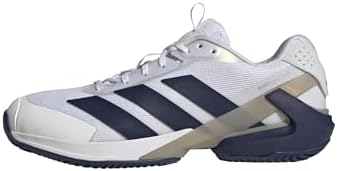
CourtJam and GameCourt models give you the outsole, lateral base and cushioning that separate a court shoe from a running shoe, without the price or the stiffness of a performance stability model. For social doubles a few times a week, that is the honest requirement.

Women Shopping the Line Specifically
Avacourt is the women’s specific option, and adidas also builds women’s versions of the other families rather than relying only on size conversion. Fit proportions differ through the heel and midfoot, which is where most sizing complaints in court shoes originate.

Men Who Want the Broadest Model Choice
The men’s court range is the deepest part of the adidas lineup, which makes it the easiest place to match a shoe to a specific movement style. Check the outsole description for the surface you play on most, since court models vary in how they are tuned for hard courts.

Comparing the Adidas Court Families
| Family | Built for | Weight and profile | Trade off |
|---|---|---|---|
| Barricade | Aggressive, frequent play | Substantial and structured | Heavier, needs a break in period |
| Adizero Ubersonic | Speed and court feel | Light and low to the ground | Less protection and shorter life under heavy use |
| CourtJam and GameCourt | Recreational play | Cushioned, moderate | Less lateral lockdown at high intensity |
| Avacourt | Women’s specific fit | Performance oriented | Narrower model choice than the men’s range |
Fit and Sizing Notes Worth Checking
Adidas court shoes are generally cut on the snugger side through the midfoot, which is intentional, since the foot needs to stay locked in place during side to side movement rather than sliding toward the outside edge. Players coming from a roomier everyday sneaker often read that as the shoe running small when it is really the court fit doing its job.
Width is the more common problem. The performance families in particular are cut relatively narrow, so players with wider feet frequently find them tight through the forefoot after an hour of play. If that describes you, compare against a brand that offers multiple width fittings, which our New Balance guide covers in detail.
Indoor and Outdoor Considerations
Most adidas court models pair a hard court outsole with a non marking rubber compound, which covers both outdoor asphalt and indoor gym floors. The difference between the two settings is wear rate rather than suitability, because abrasive outdoor surfaces grind through any court outsole faster than wood or synthetic indoor flooring.
Check the individual product listing before buying if you play mostly on one surface. Some court models are tuned specifically for clay or grass rather than hard courts, and those outsole patterns are the wrong tool for a pickleball court in either setting.
Where Adidas Is Not the Obvious Choice
Players who want a shoe designed around pickleball from the start, rather than a court shoe adapted to it, sometimes prefer a brand that built its line for the sport specifically. Our Skechers Viper Court guide covers the best known example of that approach.
The other case is fit. If wide or narrow feet are your recurring problem, a brand with a multi width range solves it more reliably than sizing up in a performance court shoe, which just adds length you do not need. Still weighing the field? Start with our pickleball shoe guide.
Frequently Asked Questions
Does adidas make pickleball specific shoes? Adidas lists a pickleball shoe category built from its established court range rather than a separate technology. The requirements overlap almost completely with tennis, so the court models cover the sport properly.
Can I use adidas tennis shoes for pickleball? Yes. Tennis court shoes are built for the same lateral loads and stops that pickleball demands, and many of the same models appear in both categories.
What is the difference between Barricade and Ubersonic? Barricade is the stability and durability line with more structure and protection, while the Adizero Ubersonic is lighter and lower to the ground for speed and court feel.
Are adidas court shoes good for wide feet? The performance families are cut fairly narrow, so players with wider feet often do better with a brand offering multiple width fittings, or with the more cushioned recreational models.
Are adidas pickleball shoes non marking? Most hard court models use a non marking rubber outsole suitable for indoor gym floors, but confirm on the specific listing if your facility requires it.
Is Avacourt worth it over a unisex model? If heel slip or midfoot fit has been a problem, a women’s specific court model is generally a better starting point than adjusting sizing in a men’s last.
How long do adidas court shoes last for pickleball? That depends on surface and frequency far more than on model. Outdoor asphalt wears any court outsole down considerably faster than indoor flooring, and lighter models wear faster than stability models.
The Bottom Line
Adidas gives pickleball players tennis court engineering organized by movement style, which makes the choice unusually straightforward once you know where you sit. Barricade for players who move hard and wear shoes out, Adizero Ubersonic for speed and court feel, CourtJam or GameCourt for recreational play, and Avacourt for a women’s specific fit. Compare it against the rest of the field in our pickleball shoe guide, and see whether a tennis shoe you already own covers you before buying anything.