Last updated: August 19, 2026
Paddleball and pickleball sound like the same sport with two names, and a lot of people use them that way. They are not the same. One of them is usually played against a wall with no net at all, and the other is a net sport with a rulebook, a governing body and a court whose dimensions are written down.
The confusion is understandable, because paddleball is not one sport either. The word covers a small family of games that share a solid paddle and almost nothing else. This guide separates them, explains what each one actually involves, and helps you work out which is the one you were looking for.
Quick Answer
What is the difference between paddleball and pickleball?
- Paddleball in its most common American form is a wall sport: players hit a rubber ball against a wall with a solid paddle, with no net and no opposing side of a court.
- Pickleball is a net sport played on a 44 by 20 foot court with a perforated plastic ball, a non-volley zone at the net, and a two-bounce rule.
- The word paddleball also gets used for beach paddle games and, loosely, for paddle tennis and platform tennis, which is why the term causes so much confusion.
Bottom line: if there is a net, a kitchen and a plastic ball with holes in it, you are looking at pickleball. If the ball is coming back off a wall, you are looking at paddleball.
Paddleball vs Pickleball at a Glance
The table compares pickleball against the wall version of paddleball, since that is the sport most Americans mean by the word. Beach paddleball and the net games that borrow the name are covered further down, because they change the answer significantly.
| Category | Paddleball (wall version) | Pickleball |
|---|---|---|
| Playing area | An enclosed or one-wall court, ball played off the wall | A 44 by 20 foot court divided by a net |
| Net | None | Yes, lower than a tennis net |
| Ball | Small solid rubber ball | Hard perforated plastic ball |
| Paddle | Solid paddle, often with a wrist tether | Solid paddle, no strings, no tether |
| Core skill | Reading rebounds off walls | Placement, soft shots and net position |
| Governing body | Varies by variant and region | USA Pickleball, with a published rulebook |
What Paddleball Usually Means
In the United States, paddleball most often refers to a wall sport played with a solid paddle and a small rubber ball, in one-wall, three-wall or four-wall formats. Players alternate hitting the ball against the front wall, and the game is closer in spirit to handball or racquetball than to anything played across a net.
The sport is generally credited to Earl Riskey, a physical education instructor at the University of Michigan, who adapted the idea for handball courts around 1930. It has a long history in city parks, particularly in New York, where one-wall courts remain a fixture of public recreation areas.
The Other Games That Borrow the Name
Beach paddleball, played with wooden paddles and a rubber ball, has no court and often no scoring at all: two players simply keep a rally going. Separately, paddle tennis and platform tennis are net sports that people sometimes shorten to paddle or paddleball in conversation. None of these three is what a paddleball association means by the word.
What Pickleball Is
Pickleball is a net sport played on a court measuring 44 feet by 20 feet, the same footprint for singles and doubles, with a paddle and a hard perforated plastic ball. It has a formal rulebook maintained by USA Pickleball, sanctioned tournaments, ratings and a large recreational infrastructure.
Two of its rules have no equivalent in most racket sports. The non-volley zone, universally called the kitchen, is a 7 foot strip on each side of the net where you cannot hit the ball out of the air. The two-bounce rule requires the serve and the return to each bounce before anyone volleys. Our complete rules guide covers both in detail.
Where Pickleball Came From
Pickleball was invented in 1965 on Bainbridge Island, Washington, by three fathers improvising a game for their families on a badminton court. That origin explains a lot about the sport, including the court size and the low net. Our history of pickleball covers how the improvisation turned into a codified sport.
The Equipment Is Not Interchangeable
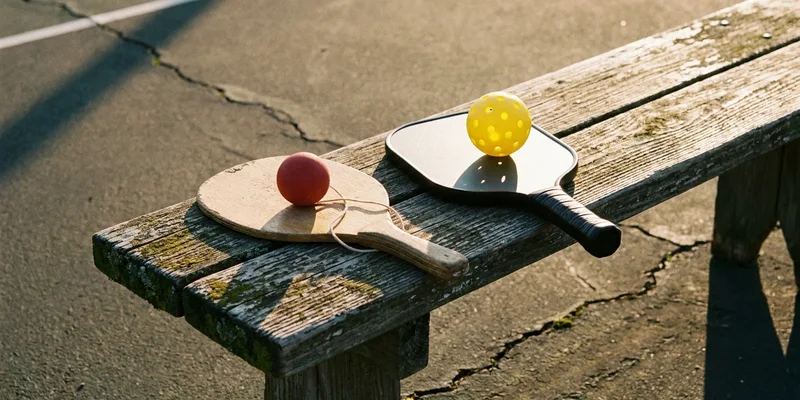
Both sports use something called a paddle, and that is roughly where the similarity ends. A paddleball paddle is built to strike a dense rubber ball repeatedly against a hard wall, is often perforated, and frequently has a wrist tether so it cannot fly out of your hand in an enclosed court.
A pickleball paddle is a composite face over a honeycomb core, tuned for touch and spin on a light plastic ball, with no tether and a much larger hitting surface relative to the ball. Using one in the other sport is not a rules question so much as a physics one: neither is built for the other ball.
The Balls Are Completely Different Objects
Paddleball uses a small, solid, high-bouncing rubber ball similar in character to a racquetball. Pickleball uses a hollow, hard plastic ball with holes drilled through it, which flies slower, is affected by wind, and bounces low. That difference alone rules out swapping equipment between the two.
How the Games Feel to Play
Paddleball rewards anticipation of rebounds. You are tracking a fast ball coming off one or more walls, often with your opponent beside you rather than opposite you, and the physical pattern is short explosive movement in a confined space. It is closer to racquetball than to any net game.
Pickleball rewards placement and patience. The two-bounce rule slows the start of every point, the kitchen pushes both sides toward the net, and a large share of rallies are decided by who can keep a soft ball low rather than who hits hardest. Our walkthrough of how a game actually runs shows the shape of a typical point.
Which One Should You Play?
Choose paddleball if you have a wall court near you, you like fast reaction sports, and you enjoy the geometry of rebounds. Choose pickleball if you want a social doubles game, a gentler entry point, and courts you can actually find, since pickleball facilities have expanded far faster than paddleball courts have.
Availability decides this for most people. Public pickleball courts, converted tennis courts and portable nets are now common in most American towns, while paddleball courts are concentrated in specific cities and older parks. The sport you can play weekly beats the sport you would slightly prefer.
If You Are Coming From a Wall Sport
Racquetball, handball and paddleball players usually pick up pickleball quickly, because the hand-eye timing transfers and the ball is slower than what they are used to. The adjustment is tactical rather than physical: no walls means no recovery from a bad shot, and the kitchen rule punishes the instinct to crowd the net and swat. Our comparison of pickleball and tennis covers the equivalent adjustment from the other direction.
Trying Pickleball Without Committing
The cheapest honest way to find out whether pickleball suits you is a basic set with two or four paddles and a few balls, borrowed or bought at entry level, plus a public court or a portable net. Nothing about a first session requires performance equipment, and paddle preferences only start to mean something once you know how you play.
If you decide to stay, upgrading a paddle is the first purchase worth thinking about. Our beginner equipment checklist covers what you genuinely need and what can wait.

Frequently Asked Questions
Is paddleball the same as pickleball? No. Paddleball in its usual American form is a wall sport with no net, played with a solid paddle and a rubber ball. Pickleball is a net sport on a marked court with a perforated plastic ball, a non-volley zone and a published rulebook.
Can you play pickleball with a paddleball paddle? Not sensibly. The two paddles are built for different balls, and a paddleball paddle is not designed for the touch shots or the larger contact area a pickleball rally demands. Sanctioned play also requires an approved pickleball paddle.
Which came first, paddleball or pickleball? Paddleball. The wall version is generally credited to Earl Riskey at the University of Michigan around 1930, while pickleball was invented in 1965 on Bainbridge Island, Washington.
Is paddleball the same as paddle tennis? No, although the names get mixed up constantly. Paddle tennis is a net sport on a small court, while paddleball in its main form is played against a wall. Platform tennis is a third, separate sport often shortened to paddle.
Which sport is easier to learn? Most complete beginners find pickleball easier to start, because the ball travels slower, the court is small, and the two-bounce rule gives you time at the start of every point. Wall sports demand faster reactions from the first rally.
Is beach paddleball a real sport? It is a real game with a large following, played with wooden paddles and a rubber ball on the sand, but it is usually cooperative rather than competitive and it has no court or net. It shares only the paddle with pickleball.
Are there paddleball courts everywhere? No. Paddleball courts are concentrated in particular cities and older public parks, while pickleball courts and converted tennis courts have spread widely. Court availability is the practical deciding factor for most players.
The Bottom Line
Paddleball and pickleball share a paddle and a syllable and very little else. Paddleball is usually a wall sport built on rebounds and reactions, with roots reaching back to the 1930s. Pickleball is a net sport with a 44 by 20 foot court, a plastic ball with holes, a kitchen rule and a governing body, and it is the far easier of the two to find a game of. If you are working out which racket or paddle sport suits you, our comparison of pickleball and tennis and our guide to padel and pickleball cover the other two questions people ask most.