Last updated: August 18, 2026
JOOLA came into pickleball from table tennis, where the brand has been established for decades, and its bag lineup reflects that background: tournament-oriented, heavy on organization, and built around players who carry more than one paddle. If you already play with a JOOLA paddle, the bags are the obvious next place to look, but the range spans everything from a minimal sling to a bag sized for a full tournament weekend.
This guide walks through how the JOOLA bag range is organized by format, which format suits which kind of player, and what to check on the spec sheet before ordering. For a broader comparison across brands, our pickleball bag guide covers the styles side by side.
Quick Answer
Which JOOLA pickleball bag should you get?
- Sling: for players carrying one or two paddles, balls, and a water bottle to a quick session.
- Backpack: the middle of the range and the one most regular players end up with, usually with a vented shoe compartment.
- Tour Elite and duffel-style bags: for multi-paddle players, coaches, and full tournament days.
- JOOLA refreshes colorways and model names periodically, so confirm the current spec sheet on the listing rather than an older review.
Bottom line: pick the format by how many paddles and how much clothing you actually carry, then check the paddle sleeve capacity.
How the JOOLA Bag Range Is Organized
JOOLA’s pickleball bags are best understood by format rather than by name, because names and colorways rotate while the formats stay constant. The range runs from a single-shoulder sling at the compact end, through backpacks in the middle, up to large tour and duffel bags built for players carrying a full tournament kit.
Across those formats, the features that repeat are a dedicated padded paddle compartment separate from the main storage, a ventilated shoe pocket on the larger models, and an insulated pocket for a water bottle on several of them. What changes between formats is capacity, how the bag is carried, and how many separate compartments the interior is divided into.
The Sling: Minimal Carry
A sling is worn across the body on one shoulder and is the fastest bag to grab for a session where you are bringing a paddle, balls, a towel, and water. It is the lightest format in the range and the least bag you can carry while still keeping a paddle in a padded sleeve rather than loose.
The limitation is straightforward: one shoulder carries all the weight, so a sling stops being comfortable once you add shoes and a change of clothes. If you regularly bring more than the basics, the backpack format is the better starting point even though the sling looks more convenient on paper.

The Backpack: The Format Most Players Land On
The backpack is the middle of the JOOLA range and the format that suits the largest share of regular players. Weight sits across both shoulders, capacity covers paddles plus a change of shoes and clothing, and the interior is divided into enough separate compartments that gear, shoes, and personal items are not sharing one pocket.
What to Check on a JOOLA Backpack
Confirm three things on the listing: the stated paddle sleeve capacity, whether the shoe compartment is ventilated or a plain sealed pocket, and whether a water bottle pocket is insulated or just an open sleeve. Those three details vary between models in the range and account for most of the difference in daily usefulness.

Tour Elite and the Large End of the Range
The Tour Elite line sits at the top of JOOLA’s bag range and is built for players who bring a full kit: several paddles, multiple pairs of shoes, layers for outdoor weather, and enough water for a long day. It is the format aimed squarely at tournament players and coaches rather than weekly open play.
These bags are noticeably larger and heavier than a backpack even before anything goes in, which is the trade-off. If you play twice a week and carry one paddle, this is more bag than the sessions justify. If your car trunk currently holds three separate bags because one is never enough, it is the format that consolidates them.
Duffel and Multi-Compartment Bags
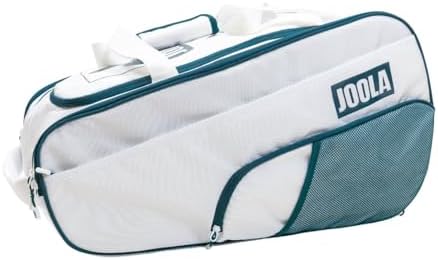
Duffel-style bags sit between a backpack and a full tour bag, holding more than a backpack while staying easier to load and unload because the main compartment opens along its length. They suit players who want capacity without the vertical bulk of a tour bag on their back.
The practical trade-off is how they are carried. A duffel is primarily a hand or single-shoulder carry, so the weight advantage of a backpack is gone. Check whether a specific model includes backpack straps if you have a long walk from parking to the courts.

Comparing the Formats
| Format | Carry | Typical use | Main limitation |
|---|---|---|---|
| Sling | One shoulder, crossbody | Quick sessions, one or two paddles | No room for a shoe change |
| Backpack | Both shoulders | Regular play, shoes plus gear | Not enough for a full tournament day |
| Duffel | Hand or one shoulder | High capacity, easy loading | Heavier to carry any distance |
| Tour Elite | Straps plus handles | Tournaments, coaching, multi-paddle | Oversized for weekly play |
Buying a JOOLA Bag to Match a JOOLA Paddle
Matching your bag brand to your paddle brand is a preference rather than a functional requirement, since any padded sleeve holds any paddle. What does matter is sleeve dimensions: elongated paddle shapes are longer than standard-shape paddles, so confirm the sleeve length if you play with an elongated model.
If you are still choosing the paddle itself, our JOOLA paddle guide covers the range, and a separate paddle cover is worth adding regardless of which bag you choose, since a sleeve protects a paddle in transit but not while it sits face down on a bench between games.
Mistakes to Avoid
The most common one is buying the largest bag in the range because it is the flagship. Capacity you never use is weight you carry every session, and a tour bag half empty is less pleasant to move around than a backpack that fits. Size to a normal session rather than to the busiest day of your year.
The second is assuming every model in the range has the same feature set. Ventilated shoe compartments, insulated bottle pockets, and paddle sleeve capacity differ between models, and specs also change when a line is refreshed. Read the current listing rather than relying on a description of last season’s version.
Frequently Asked Questions
How many paddles does a JOOLA pickleball bag hold? It depends entirely on the format, from a one or two paddle sling up to a multi-paddle tour bag. Check the stated paddle sleeve capacity on the specific listing rather than assuming a range-wide number.
Do JOOLA bags have a shoe compartment? The larger backpack, duffel, and tour formats generally include one. Confirm whether it is ventilated, since a sealed shoe pocket traps moisture and odor after an outdoor session.
Is the Tour Elite bag worth it for a recreational player? Usually not. It is built for tournament days and multi-paddle players, and for weekly open play a backpack covers the same needs with less bulk and weight.
Will a JOOLA bag fit an elongated paddle? Most paddle sleeves are sized generously, but elongated shapes are longer than standard ones, so check the sleeve dimensions on the listing if you play with an elongated paddle.
Do you need a JOOLA bag if you play with a JOOLA paddle? No. Any padded paddle sleeve holds any brand of paddle. Matching brands is a style preference rather than a compatibility requirement.
Sling or backpack for someone playing twice a week? A backpack, if you change shoes at the court or bring a change of clothes. A sling is enough only when you are carrying a paddle, balls, a towel, and water.
The Bottom Line
Choose a JOOLA pickleball bag by format rather than by name, since the formats are stable while colorways and model names rotate. A sling covers quick sessions, a backpack covers most regular players, and Tour Elite and duffel formats are for tournament days and multi-paddle kits. Confirm paddle sleeve capacity and shoe compartment ventilation on the current listing, then compare against the alternatives in our pickleball bag guide and the Selkirk bag range.