Last updated: August 19, 2026
Two millimetres sounds like a rounding error, and yet core thickness is the field most experienced players check before anything else on a paddle listing. It is the one number that reliably predicts whether a paddle will feel firm and fast or soft and forgiving, which is why so many models are sold in both options under the same name.
This guide explains what the two thicknesses actually change, who tends to end up with which, and why the honest answer to the question involves a fair amount of personal preference. We do not test paddles ourselves, so what follows is how manufacturers position the two builds and what players consistently report about them.
Quick Answer
14mm or 16mm: which pickleball paddle core should you buy?
- A 14mm core is the firmer, more direct build. Manufacturers position it toward pace and a connected feel, and it suits players who already make clean contact.
- A 16mm core is the softer, more forgiving build. It is positioned toward control, a longer dwell on the face and more margin on off centre hits.
- Most recreational players are better served by 16mm, and most players who think they need 14mm are trying to solve a technique problem with a purchase.
Bottom line: thickness sets the feel, not the outcome. It interacts with shape, weight and face material, so treat it as one field among several rather than a verdict.
14mm vs 16mm at a Glance
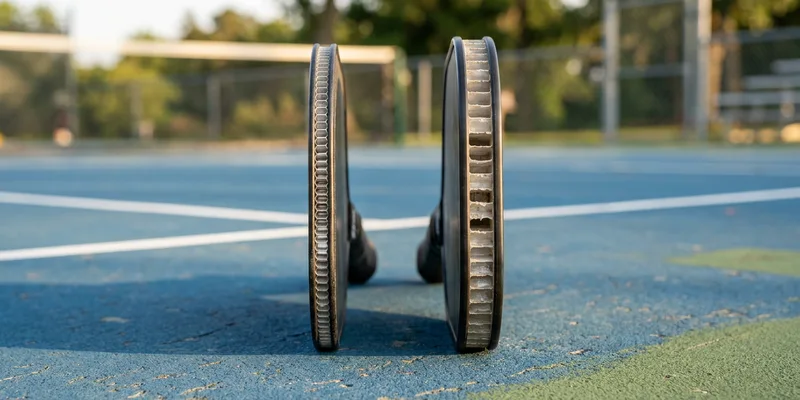
Core thickness describes the depth of the honeycomb core sandwiched between the two faces of the paddle. A thinner core compresses less and returns the ball faster off the face. A thicker core absorbs more of the incoming pace and gives the ball fractionally longer on the face, which players read as touch.
| What changes | 14mm core | 16mm core |
|---|---|---|
| Feel off the face | Firm, direct, connected | Softer, cushioned, muted |
| Positioned toward | Pace and put-aways | Control and resets |
| Forgiving zone | Generally described as smaller | Generally described as larger |
| Feedback on mishits | More noticeable | More absorbed |
| Typical buyer | Drivers and singles players | Doubles and kitchen-line players |
| Common regret | Drops and resets sail long | Struggling to finish a point |
What the Core Actually Does
The core is the sprung layer of a paddle. When the ball arrives, the core compresses and then pushes back, and how much it compresses over how long is what your hand reads as feel. Thinner cores compress less and rebound quicker, thicker cores compress more and hold the ball a fraction longer before releasing it.
That single mechanical difference is where every claim about power and control comes from. Nothing mysterious happens inside a paddle, and no marketing term changes the physics of a deeper or shallower honeycomb layer between two carbon faces.
Why Thicker Often Feels Bigger
A thicker core spreads the impact across more material, so the response at the edge of the face is closer to the response in the middle. Players experience that as a larger sweet spot, even though the face has not changed size. On a thinner core the difference between a centred hit and an off centre one is more obvious in the hand and in the result.
Who Should Choose 14mm
Choose the thinner core if you already generate your own pace, your contact point is reliable, and the shots you lose are put-aways rather than resets. A 14mm build gives you a more immediate response, which matters most on counters, speed-ups and drives where a fraction of extra pop decides the point.
Singles players lean this way more often than doubles players, because singles rewards driving the ball and covering the court rather than winning long dinking exchanges. Players moving up from a soft paddle also sometimes want the thinner core purely for the feedback, since the firmer response tells you more about where on the face you made contact.
The Honest Warning on 14mm
A thinner core amplifies what you already do, including the mistakes. If your third shot drop already sails long under pressure, more pop makes that worse rather than better. Our guide to the third shot drop is a better fix for that particular problem than a paddle purchase is.

Who Should Choose 16mm
Choose the thicker core if your game runs through the soft shots, if you play mostly doubles, or if you are still building consistency. A 16mm build absorbs more of the incoming pace, which is exactly what a reset needs, and it is more forgiving when the ball catches the upper or outer part of the face.
This is also the safer default for anyone who is unsure. The trade you make is real but modest: you will work slightly harder to finish a point, and you get margin on every touch shot in return. Our control paddle guide covers the three different things players mean when they say control, which is worth reading before you assume thickness alone will deliver it.
Thicker Is Not Automatically Softer
Construction matters as much as depth. A thermoformed paddle with foam in the perimeter can feel firmer at 16mm than an older cold-pressed build does at 14mm, because the walls and the manufacturing method change the stiffness of the whole structure. Compare thickness within a similar build, not across different eras of construction.
Why the Feel Is Genuinely Personal
Two players can hit the same 16mm paddle and describe it in opposite terms, and neither of them is wrong. Feel depends on your grip pressure, your swing speed, how hard your opponents hit, and what you played before. A paddle only ever feels soft or firm relative to the last one you owned.
That is why paddle forums never resolve this question and why any guide that declares one thickness correct is overselling. The useful framing is not which is better but which mistake you would rather make, and you can only answer that honestly by looking at where your own points go.
What Actually Matters More Than Thickness
Shape, static weight, balance and grip size all change how a paddle plays, and in several cases they change it more than two millimetres of core does. An elongated 16mm paddle can feel less forgiving than a wide-body 14mm one, because the outline moved the forgiving zone before the core ever got a say. Our framework for how to choose a pickleball paddle puts the fields in order.
What About 13mm, 11mm and 19mm?
Manufacturers sell thicknesses outside the two headline options, and the same logic scales in both directions. Anything below 14mm is generally positioned as a specialist power build, and anything above 16mm is generally positioned as a specialist control build for players who want maximum absorption at the kitchen.
The further you go from the middle, the more specialised the paddle becomes and the more it asks of the rest of your game. For most players the two common options genuinely do cover the useful range, which is why brands keep building them.
Face Material Changes the Answer
Core thickness never acts alone. The face material sets how much bite the paddle puts on the ball and how stiff the hitting surface is, so a raw carbon face and a fibreglass face at the same thickness are not comparable. Fibreglass is generally described as livelier, carbon as more controlled and better for spin.
Spin also comes from surface texture rather than from the core, and texture wears down with use on every brand. If spin is what you are shopping for, our guide to what actually grips the ball and our overview of carbon fiber paddles matter more than the thickness field does.

Does Thickness Affect Tournament Approval?
Approval is decided per model, not per thickness, and USA Pickleball publishes current results on its official Approved Paddle List at usapickleball.org. A brand submitting both builds of the same paddle submits them as separate entries, so the thickness you buy is part of what you need to look up.
For casual open play none of this applies, since equipment is not enforced. If you compete, search the exact model string, including the thickness variant, on the official list before you buy. Our overview of what the approval label means explains how the list works.
Frequently Asked Questions
Is 14mm or 16mm better for beginners? A 16mm core is the more forgiving starting point for most new players, because it absorbs more incoming pace and gives more margin on off centre contact while you are still building consistent technique.
Does a 14mm paddle really give more power? Manufacturers position the thinner core toward pace, and players consistently report a firmer, more direct response. How much extra pace you actually see depends on your swing, so treat it as a change in feel rather than a guaranteed gain.
Which thickness is better for dinking? A 16mm core generally suits the soft game better, since the extra absorption makes resets and dinks easier to keep low. Grip pressure and paddle weight also affect touch, so thickness is only part of the answer.
Can you tell the difference between 14mm and 16mm? Most players can feel the difference immediately when hitting the two back to back, especially on resets. Describing it in words is harder than sensing it, which is why paddle recommendations vary so much between players.
Do pros use 14mm or 16mm paddles? Both are used at the top level and the split varies by playing style and event. Copying a professional’s setup is rarely useful, since their contact point moves far less than a recreational player’s does.
Is a thicker paddle heavier? Not necessarily. Static weight depends on the whole build, including face material, edge guard and handle, so a 16mm paddle can weigh the same as or less than a 14mm one from another line. Check the listed weight range separately.
The Bottom Line
The 14mm against 16mm question is a choice between two feels, not between a good paddle and a bad one. Thinner cores are positioned toward pace and give sharper feedback, thicker cores absorb more and forgive more, and 16mm is the safer default for most recreational doubles players. Read thickness alongside shape, weight and face material rather than on its own, and accept that the final call is partly personal. If you are still building a shortlist, our guides to paddles for power and first paddles narrow the field faster than a spec table does.
Related Reading
- Pickleball Paddle for Control: Which Kind Do You Need
- Pickleball Paddle for Spin: What Actually Grips the Ball
- How to Choose a Pickleball Paddle
- Carbon Fiber Pickleball Paddles: What the Material Changes
- Elongated Pickleball Paddles: What the Shape Costs You
- Pickleball Paddle for Advanced Players: How to Choose
- How Long Do Pickleball Paddles Last?